What to Have Ready Before Sewer Repair in Rancho Palos Verdes, CA
A little preparation before sewer repair saves time on site and helps the crew find the cause faster. Here is what to have ready: the symptoms, the lowest drain, the rain pattern, the home age, and the cleanout.
Rancho Palos Verdes Sewer Line Pros · 2026-11-17 · Guides
The short version
Problem: Write down the symptoms, which drains are affected, and whether the problem follows rain.
What to do: Find the cleanout, note the age of the home, and know where the water shutoff sits.
When to call: Call Now if wastewater is coming into the home, or have the line inspected with the details ready.
Write down the symptoms
Write down what is happening, before the crew arrives. Note which drains are slow, which toilet gurgles, where a backup appears, and whether a sewer smell is present. Note when each symptom started, and whether it is getting worse. A symptom that started last week is a different problem from one that has been growing for a year, and the crew needs to know which one it is. Note which drains are slow, which toilet gurgles, where a backup appears, and whether a sewer smell is present, because each symptom points to a different part of the lateral.
Note what makes the symptoms worse. A problem that appears only when the washing machine runs points to a restriction that a large flow overwhelms. A problem that appears with any fixture points to a restriction that is further along. A problem that appears only in heavy rain points to the street side or to storm water entering the lateral. The pattern is useful information, and it is worth writing down. A symptom that started last week is a different problem from one that has been growing for a year, and the crew needs to know which one it is before they plan the inspection.
Note what has already been done. A line that has been cleaned before, and when, and what the cleaning found, is part of the history. A line that was cleared for roots last year and blocked again this year is a line problem, not a blockage problem. The notes turn a vague complaint into a description the crew can work from, and they save time on site. A problem that appears only when the washing machine runs points to a restriction that a large flow overwhelms, while one that appears with any fixture points to a restriction that is further along.
Know the lowest drain and the rain pattern
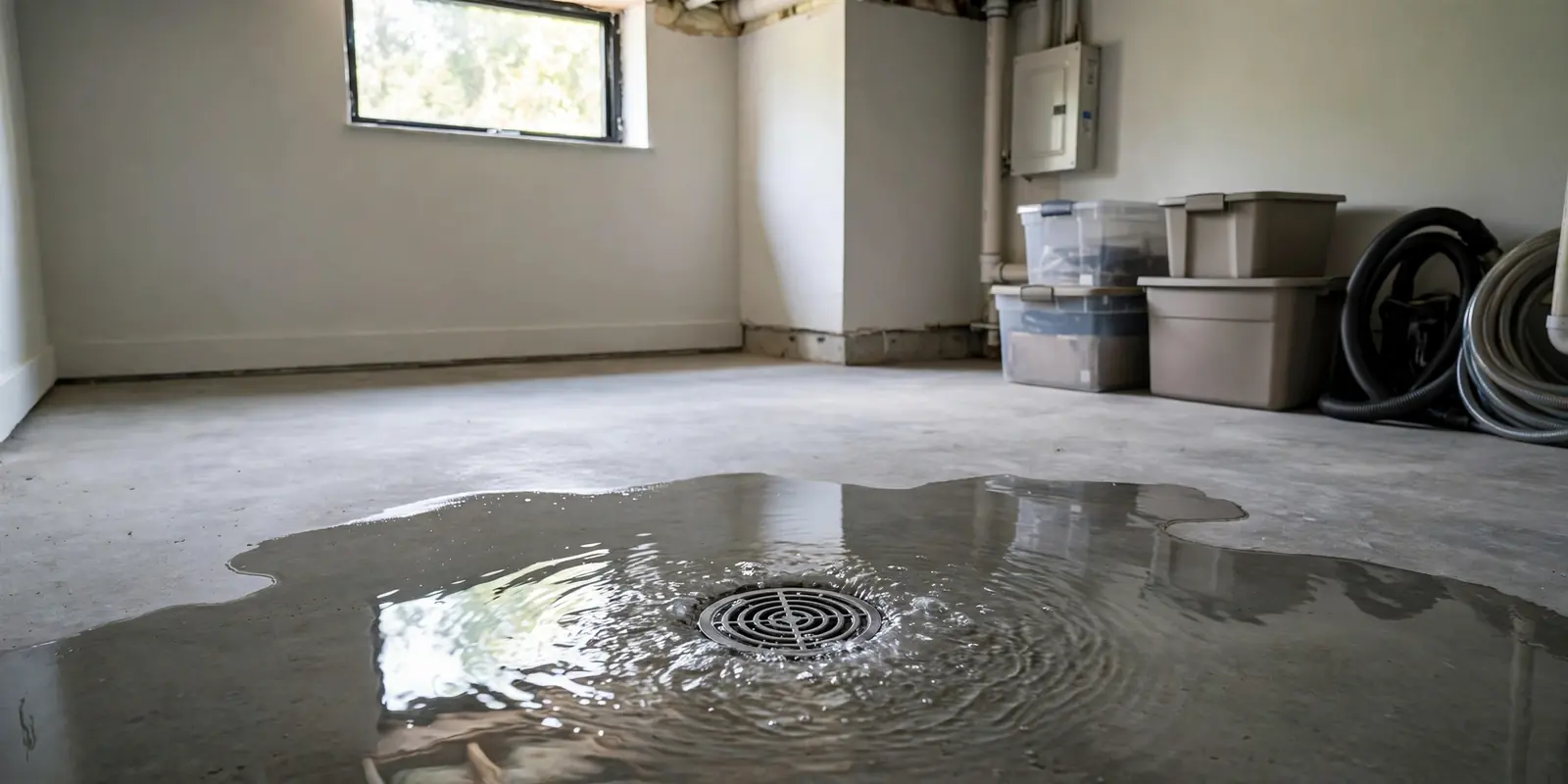
Find the lowest drain in the house. It is usually a floor drain, a shower on the lowest level, or a toilet that sits lower than the rest of the house. The lowest drain is the first place a backup shows, and it is the drain the crew will watch when water is run in the house. Knowing where it is, and whether it has backed up before, helps the crew decide where to look first. A line that was cleared for roots last year and blocked again this year is a line problem, not a blockage problem, and the history is part of the diagnosis the crew needs to hear.
Note the rain pattern. A backup that happens only in heavy rain, and clears when the rain stops, points toward the street side rather than a blockage inside the house. A backup that happens in dry weather points to the lateral itself. Note the dates of the backups, and whether it was raining, because the history is part of the diagnosis, and the camera inspection after the rain is what separates the two. The lowest drain is usually a floor drain, a shower on the lowest level, or a toilet that sits lower than the rest of the house, and it is the first place a backup shows.
Note whether neighbours have the same problem. A backup that affected several homes on a street points toward the street side, while a backup that affected only one home points to that home's lateral. The neighbours are worth asking, because a street-side problem and a lateral problem look the same inside one house, and the pattern across the street separates them. A backup that happens only in heavy rain points toward the street side, while one that happens in dry weather points to the lateral itself, and the dates and the rainfall are worth noting.
Know the age of the home and the pipe
Note the age of the home. The median year homes in Rancho Palos Verdes were built is 1967, and more than four in five homes date from before 1980. A home built in the 1950s or 1960s almost always has a clay tile or bituminous fiber lateral with cast iron at the house end, unless it has already been replaced. The age is a clue to the material, and the material is a clue to the failure pattern. A backup that affected several homes on a street points toward the street side, while one that affected only one home points to that home's lateral, so the neighbours are worth asking.
Note any past work on the line. A lateral that was lined, burst, or replaced, and when, is part of the history, and the records for that work are worth finding. The camera footage from a past inspection, the written findings, and any paperwork from past work are all useful, because they show the line's condition at a point in time, and a later inspection can be compared against them. The median year homes in Rancho Palos Verdes were built is 1967, and a home built in the 1950s or 1960s almost always has a clay tile or bituminous fiber lateral unless it has already been replaced.
Note any work in the yard. A driveway that was laid over the line, a patio that was built above it, or a tree that was planted over it are all factors the crew needs to know, because they affect where the line runs, how deep it is, and what sits above it. The crew explains where the line runs when the work is done, and the notes about the yard help them plan the dig. Camera footage from a past inspection shows the line's condition at a point in time, and a later inspection can be compared against it to see whether the line is stable or failing.
Find the cleanout and the water shutoff
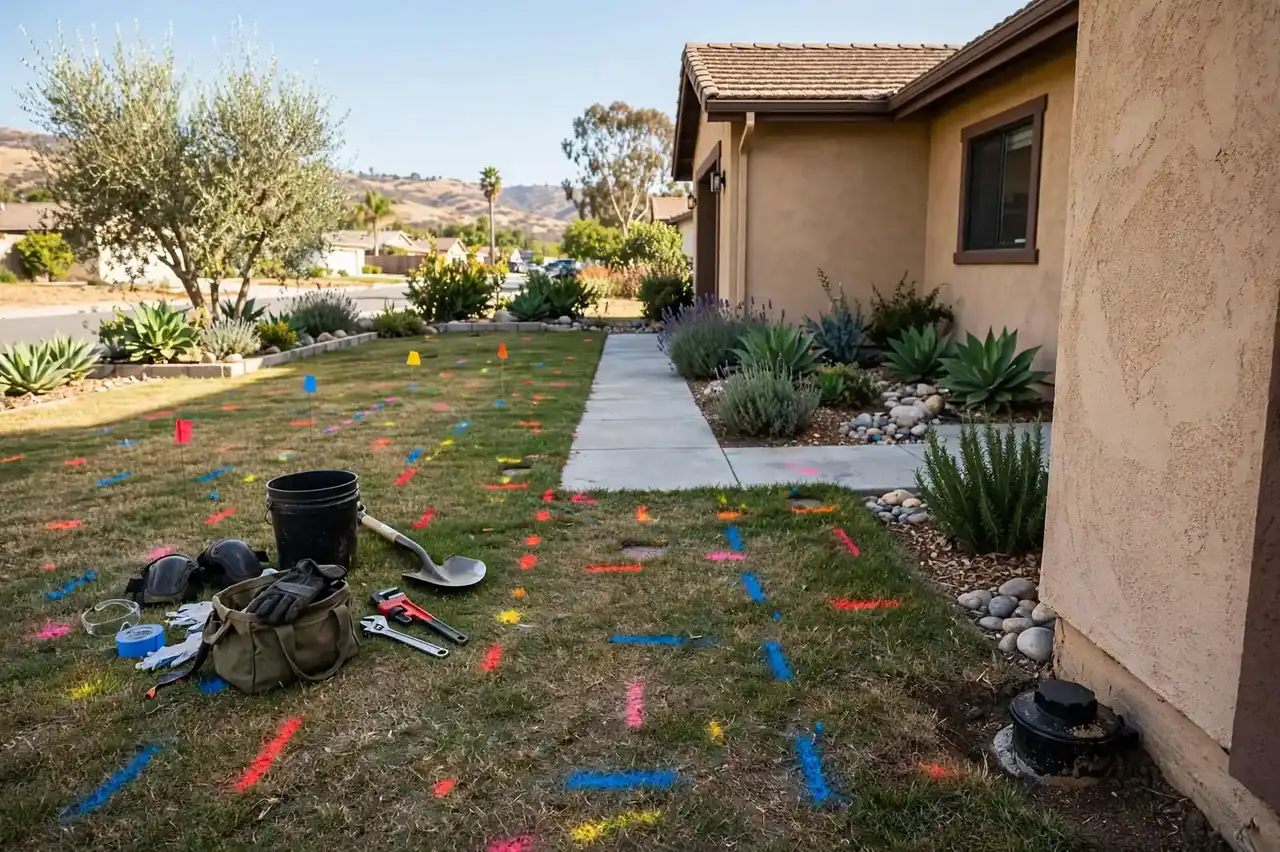
Find the cleanout. A cleanout is an access point in the lateral, usually a capped pipe near the house, in the yard, or in a lower level, and it is where the camera and the cable enter the line. A cleanout makes the job easier and faster, because the camera can enter without pulling a toilet. If there is no cleanout, the crew will find another access point, but knowing where the cleanout is saves time. A driveway laid over the line, a patio built above it, or a tree planted over it are all factors the crew needs to know, because they affect where the line runs and what sits above it.
Clear the path to the cleanout before the crew arrives. Move anything that blocks it, and make sure the crew can reach it with their equipment. A cleanout behind a locked gate, under a pile of stored items, or under a deck is a cleanout the crew cannot use, and the work slows while access is sorted out. A clear path is a small step that saves real time on site. A cleanout is an access point in the lateral, usually a capped pipe near the house, and it is where the camera and the cable enter the line without pulling a toilet.
Know where the water shutoff sits, and how to turn it off. Water use in the house is paused while the line is being worked on, because the lateral is open, and the crew will explain the timing before work starts. Knowing the shutoff in advance means the household can plan around the pause, and the crew does not have to search for it when the work starts. Clearing the path to the cleanout before the crew arrives saves time on site, because a cleanout behind a locked gate or under stored items is one the crew cannot use.
Clear the work area and plan for the day
Clear the work area in the yard. The lateral runs from the house to the street main, usually in a straight line, and the crew will need access along that line for the locate, the digging, and the equipment. Move cars, bins, and anything that sits over the line, and make sure the crew can bring their equipment to the front yard without obstruction. Knowing where the water shutoff sits means the household can plan around the pause in water use, and the crew does not have to search for it when the work starts.
Plan for the day of the work. Water use will be paused while the line is open, and the crew will explain the timing before work starts, so the household can plan around it. The pause is usually measured in hours, not days, for the part of the job when the line is open, but it is worth planning for, especially where the household includes children or older people. Moving cars and bins off the line from the house to the street gives the crew access for the locate, the digging, and the equipment, and a clear yard saves real time on site.
Keep pets and children away from the work area while the job runs. A trench or two pits, a mini excavator, pipe sections, and backfill material are all in the front yard, and the site is a work site, not a play area. The crew keeps the site tidy, but the yard is not safe for children or pets while the work is in progress, and the household should plan for that. Keeping pets and children away from the work area matters, because a trench, a mini excavator, pipe sections, and backfill material make the front yard a work site while the job runs.
Related: RPV Sewer Permits · Sewer Line Replacement · sewer line repair across Rancho Palos Verdes
Related guides
 Guides
Sewer Replacement Process Step by Step in Rancho Palos Verdes, CA
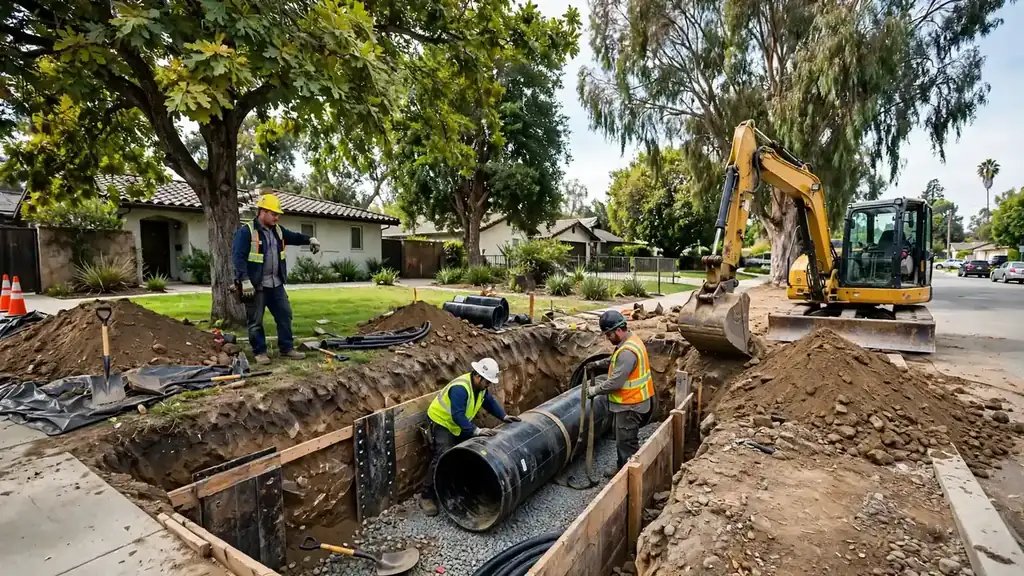
A sewer replacement follows the same steps in every Rancho Palos Verdes home: a call, a camera inspection, options from the findings, a locate and permits, the work, a final camera check, and restore.
 Guides
What a Sewer Camera Inspection Shows in Rancho Palos Verdes, CA
A camera inspection shows the inside of your lateral — the material, the damage, and the location — so the fix matches the problem instead of the guess.
 Signs & Symptoms
Sewage Backup in the Lowest Drain in Rancho Palos Verdes, CA
Wastewater coming up through the lowest drain is an urgent problem. Stop using water, keep away from the wastewater, and call for help — then have the cause found on camera.
Frequently asked questions
Questions people ask about this topic, answered plainly.
Write down the symptoms, which drains are affected, when the problem started, and whether it follows rain. Note what has already been done to the line, and whether neighbours have the same problem. Those details help the crew decide where to look first. Write down the symptoms, which drains are affected, when the problem started, and whether it follows rain, because those details help the crew decide where to look first.
A cleanout is usually a capped pipe near the house, in the yard, or in a lower level, and it is where the camera and the cable enter the line. If you cannot find it, the crew will find another access point, but knowing where it is saves time on site. A cleanout is usually a capped pipe near the house, in the yard, or in a lower level, and it is where the camera and the cable enter the line without pulling a toilet.
If wastewater is coming into the home, stop using water at once, with no taps, no flushing, and no washing machine or dishwasher. If the drains are slow but not backing up, use water normally until the crew arrives, and they will explain when to pause it. If wastewater is coming into the home, stop using water at once, and if the drains are slow but not backing up, use water normally until the crew arrives and explains when to pause it.
It helps. Camera footage from a past inspection, written findings, and any paperwork from past work show the line's condition at a point in time, and a later inspection can be compared against them. Find what you can, and the crew will work with what is there. Camera footage from a past inspection and any paperwork from past work show the line's condition at a point in time, and a later inspection can be compared against them.
Clear the path to the cleanout, and move cars, bins, and anything that sits over the line from the house to the street. The crew needs access along that line for the locate, the digging, and the equipment, and a clear yard saves time on site. Clear the path to the cleanout, and move cars, bins, and anything that sits over the line from the house to the street, so the crew has access for the locate and the digging.
The crew can work without it, but the age is a useful clue to the pipe material. A home built in the 1950s or 1960s almost always has a clay tile or bituminous fiber lateral with cast iron at the house end, unless it has already been replaced. The camera inspection shows the material for certain. The age of the home is a useful clue to the pipe material, and a home built in the 1950s or 1960s almost always has a clay tile or bituminous fiber lateral unless it has already been replaced.
Still have questions?
Call Now to reach a local sewer professional — describe the problem and what the line has been doing.
Call now for sewer line help
Tap Call Now to reach a local sewer professional. Tell them where the problem is, what the line has been doing, and whether wastewater is coming into the home.
Hours: Mon–Fri 7:00 AM–10:00 PM PT · Sat 8:00 AM–10:00 PM PT · Sun 7:00 AM–9:00 PM PT
Before you call
- Stop using water if the line is backing up.
- Keep people and pets away from any wastewater.
- Note which drains are slow, and which one backs up first.
- Note whether the problem happens in heavy rain, or all the time.
- Have the age of the home ready, if you know it.