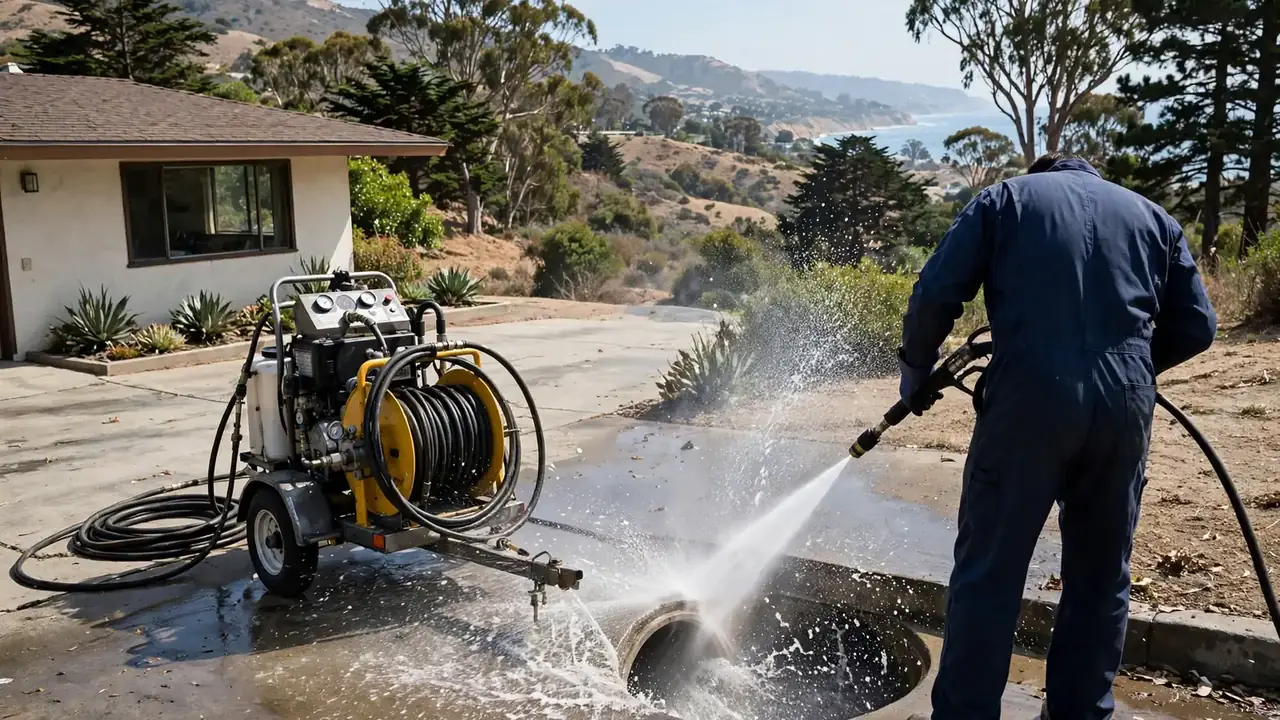
Hydro Jetting Rancho Palos Verdes, CA
Hydro jetting scours the inside of a sewer line with high-pressure water, clearing roots, grease, and scale that a cable only pokes a hole through.
Need help with your sewer line?
Call Now to reach a local sewer professional. Describe the problem, where it is, and what the line has been doing.
Hours: Mon–Fri 7:00 AM–10:00 PM PT · Sat 8:00 AM–10:00 PM PT · Sun 7:00 AM–9:00 PM PT
What this service does
Hydro jetting cleans a sewer line with water at high pressure. A hose with a specially designed nozzle is fed into the line, and jets of water fire backward and forward, scouring the pipe walls as the hose moves through. Grease, soap scum, scale, and root masses are cut away and flushed downstream to the street main. The result is a pipe that is clean all the way around — not just open in the middle. The water does the work, not a chemical. No solvents or drain cleaners go into the line, and nothing is left behind in the pipe except clean walls. The debris the jetting loosens is flushed downstream to the street main, where it joins the flow the main already carries. For a homeowner who has poured drain cleaner down a slow drain more than once, jetting is the step that actually removes the material the cleaner could not dissolve.
The difference between jetting and snaking matters, because the two tools do different jobs. A drain snake, or cable, punches a hole through a blockage so water can pass again. It does not clean the walls of the pipe, and it does not remove the root mat or the grease layer that caused the blockage. Hydro jetting removes the material itself. That is why a line that has been snaked three times in a year often stays clear much longer after one jetting. The difference shows up in how long the result holds. A cable opens a channel through a root mat, and the mat closes around the channel as the roots keep growing. A jetter cuts the mat away and scours the wall behind it, so the roots have to grow back from the joint rather than from a mat that is still in the pipe. The line stays open longer, and the next clearing, when it comes, starts from a cleaner pipe.
In Rancho Palos Verdes, jetting is often the first step before anything else happens. A line that is blocked solid cannot be camera-inspected until it is cleared, and jetting clears it without the scraping a cable can do to an old pipe. The city's laterals are mostly clay tile, cast iron, and bituminous fiber from the 1950s through the 1970s, and a camera inspection after jetting shows the true condition of the pipe — the cracks and joints that were hidden behind the buildup. Jetting is also the step that makes the rest of the work possible. A camera cannot see through a blockage, a liner cannot bond to a dirty pipe wall, and a bursting head cannot be pulled through a line that is choked with roots. In each case, the jetter goes first, and the inspection or the repair follows on a clean line. That order, clear, inspect, then repair, is what keeps a sewer job from becoming a guess.
Before you call
- Stop using water if the line is backing up.
- Keep people and pets away from any wastewater.
- Note which drains are slow, and which one backs up first.
- Note whether the problem happens in heavy rain, or all the time.
- Have the age of the home ready, if you know it.
How hydro jetting works, and when it is the right tool
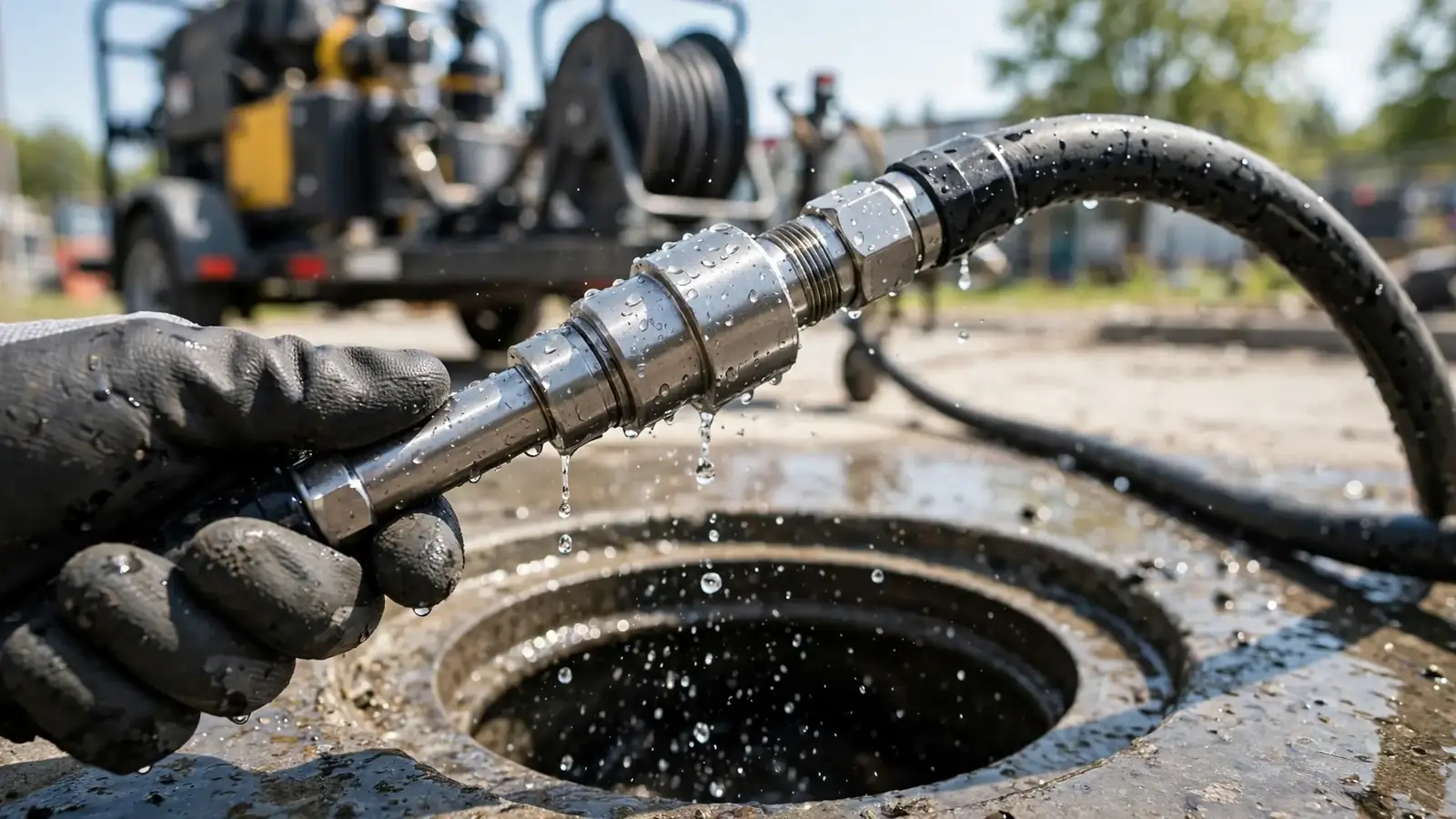
A hydro jetter is a pump, a hose, and a nozzle. The pump pressurizes water and sends it down the hose to the nozzle, which has jets angled backward and forward. The backward jets pull the hose through the pipe and scour the walls; the forward jet cuts into the blockage ahead. The operator controls the pressure and the speed, moving the hose back and forth through the dirty sections until the water coming back runs clear. Different nozzles suit different jobs — one for grease, one for roots, one for scale. The operator works the hose back and forth through the dirty sections rather than pushing it straight through, because a single pass leaves buildup on the walls. The water coming back out of the line tells the operator when the section is clean: it runs clear instead of carrying grease, grit, and root cuttings. The job is done when the return water is clear and the camera shows clean walls, not when the hose has simply reached the street.
Jetting is the right tool when the problem is buildup inside the pipe: grease from kitchens, soap and hair from bathrooms, scale inside old cast iron, and root masses at clay tile joints. It is also the right tool for clearing a line before a camera inspection, because the camera needs to see the pipe, not the blockage. What jetting cannot do is fix a broken pipe. A collapsed section, a separated joint, or a bad belly is a structural problem, and no amount of water pressure changes the shape of the pipe. Grease is the buildup jetting handles most often in a kitchen line, and it is also the one a cable handles worst, because a cable pokes a hole through grease and the grease closes behind it. Scale is the opposite problem: it is hard, it narrows old cast iron over decades, and only a descaling nozzle scours it off the wall. Roots are the third kind, and a root nozzle cuts them at the joint where they entered. Each buildup has its own nozzle, and the operator chooses it from what the line is carrying.
The question homeowners ask most is whether jetting is safe for old pipes. The answer is that the pressure is adjustable, and a professional sets it for the pipe in front of them. A clay tile line from the 1960s is jetted at a lower pressure than a newer plastic line, and the nozzle is chosen for the material. A line that is already collapsed or badly cracked is not jetted at all — it is camera-inspected first, and the structural problem is handled as a repair. The pressure setting is part of the job, not an afterthought. A clay tile line from the 1960s is jetted at a lower pressure than a newer plastic line, and the nozzle is chosen for the material as well as for the buildup. A line that is already cracked is jetted gently or not at all, because the point of the work is to clean the pipe, not to test how much pressure a damaged joint can take.
What the service includes
Camera check before jetting
The line is assessed before the jetter goes in, so a collapsed or badly cracked pipe is not jetted. A line that cannot take the pressure is handled as a repair instead, and the camera comes first.
Root-cutting nozzle work
A root-cutting nozzle slices through root masses at clay tile joints and flushes the cuttings downstream. The roots are removed from the pipe, not just pushed aside, so the line flows again.
Grease and scale removal
High-pressure water strips grease, soap residue, and scale from the pipe walls, including the hard scale that builds up inside old cast iron over decades. The bore of the pipe is restored, not just opened.
Full-length cleaning
The hose is run the full length of the line to the street main, so the whole lateral is cleaned — not just the section near the house where the symptoms showed up.
Debris flushed to the main
The cuttings and the loosened buildup are flushed downstream to the street main, so nothing is left in the line to catch the next load of wastewater and start the blockage again.
Camera check after jetting
The line is camera-inspected after the jetting, so the true condition of the pipe shows through — the cracks, joints, and bellies that were hidden behind the buildup.
How the work runs
Describe the symptoms
Slow drains, repeat backups, gurgling fixtures, or a line that has been snaked before and blocked again. Where the problem shows up tells the crew which section of the line to work first.
Assess the line
The line is checked before jetting, so a collapsed or badly cracked pipe is found before the jetter goes in. A line with a structural failure is not jetted.
Choose the nozzle and pressure
The nozzle and the pressure are set for the pipe material and the kind of buildup — a root nozzle for roots, a grease nozzle for grease, a lower pressure for old clay tile.
Jet the line
The hose is fed through the line to the street main and worked back and forth through the dirty sections until the water runs clear and the walls are scoured.
Flush to the main
The loosened material is flushed downstream to the street main, leaving the line clean along its full length rather than cleared in one spot.
Camera check and findings
The camera runs the cleaned line, and the crew explains what it shows — whether the pipe is sound, or whether the buildup was hiding a crack, a belly, or a joint full of roots.
Tools and methods used
Hydro jetter pump
The pump pressurizes water and drives it down the hose to the nozzle. The pressure is adjustable, so the operator sets it for the pipe material in front of them.
Root-cutting nozzle
A nozzle with forward cutting jets slices through root masses at clay tile joints, then flushes the cuttings downstream to the street main.
Grease and descaling nozzles
Different nozzle designs suit different buildup — one for grease and soap residue, another for the hard scale that narrows old cast iron pipe.
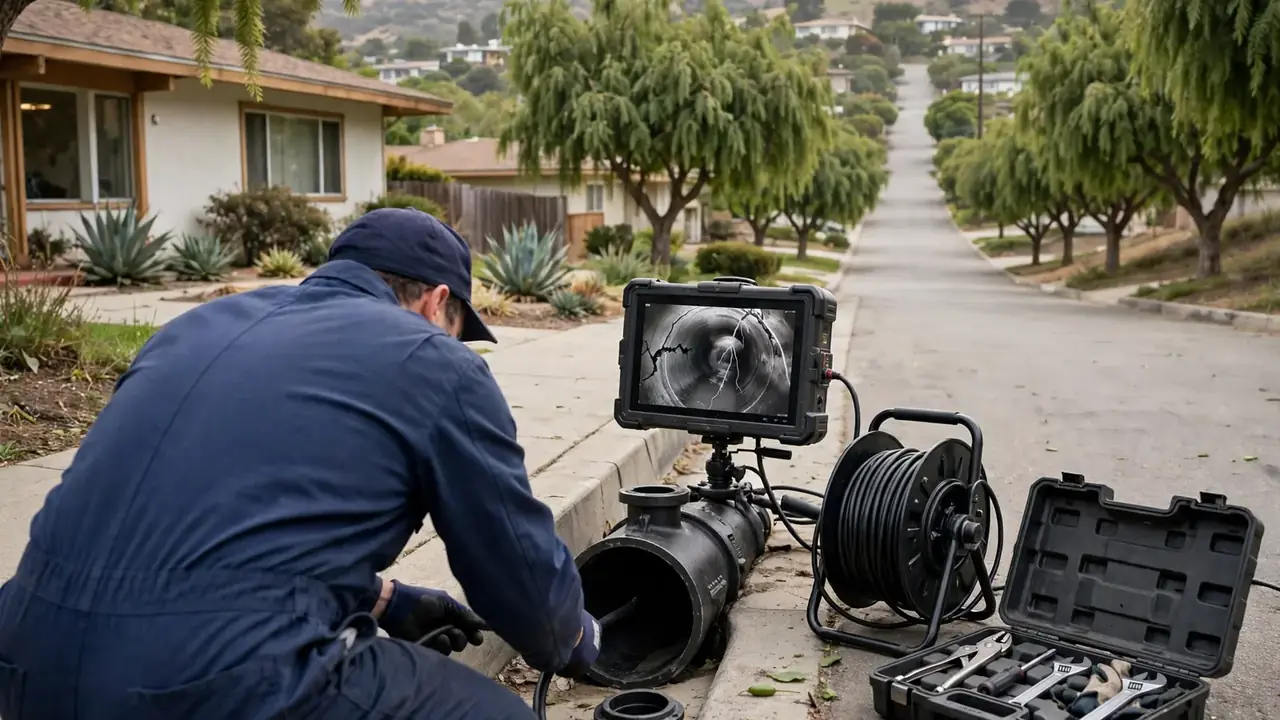
Sewer camera
The camera runs before jetting to check the line can take it, and after jetting to show the true condition of the pipe once the buildup is gone.
Hydro jetting cost: what decides it
Hydro jetting, also called water jetting, has no single figure, because the hydro jetting sewer line cost follows the condition of the line. The length of the run matters, and so does the severity of the blockage: a light buildup of grease clears faster than a root mat that has filled the pipe, and scale inside cast iron takes longer than soft sludge. Access matters too: the jetter needs an entry point, and a line with a cleanout at the surface is entered directly, while a line without one needs access created first. A camera run after the jetting is part of the job, because it shows whether the line is clear and what caused the blockage in the first place.
The machine itself is part of the story. A jetter is a high-pressure water unit with nozzles chosen for the job — a nozzle that cuts roots is different from one that scours scale — and the pressure is set to the pipe in front of it. Old clay and cast iron need care, because too much pressure on a fragile line can do damage, and the operator sets the pressure from what the camera showed before the jetting started. A rented machine is not the same job: rental units run at lower pressure and come without a camera, so they can clear the surface of a blockage without showing what caused it. The pros and cons of hydro jetting are straightforward. The pros are that it clears the full bore, uses water rather than chemicals, and leaves the line camera-verified. The cons are that it is not a repair: it clears a line, it does not fix a cracked, bellied, or collapsed pipe, and a line that needs repair still needs it after the jetting.
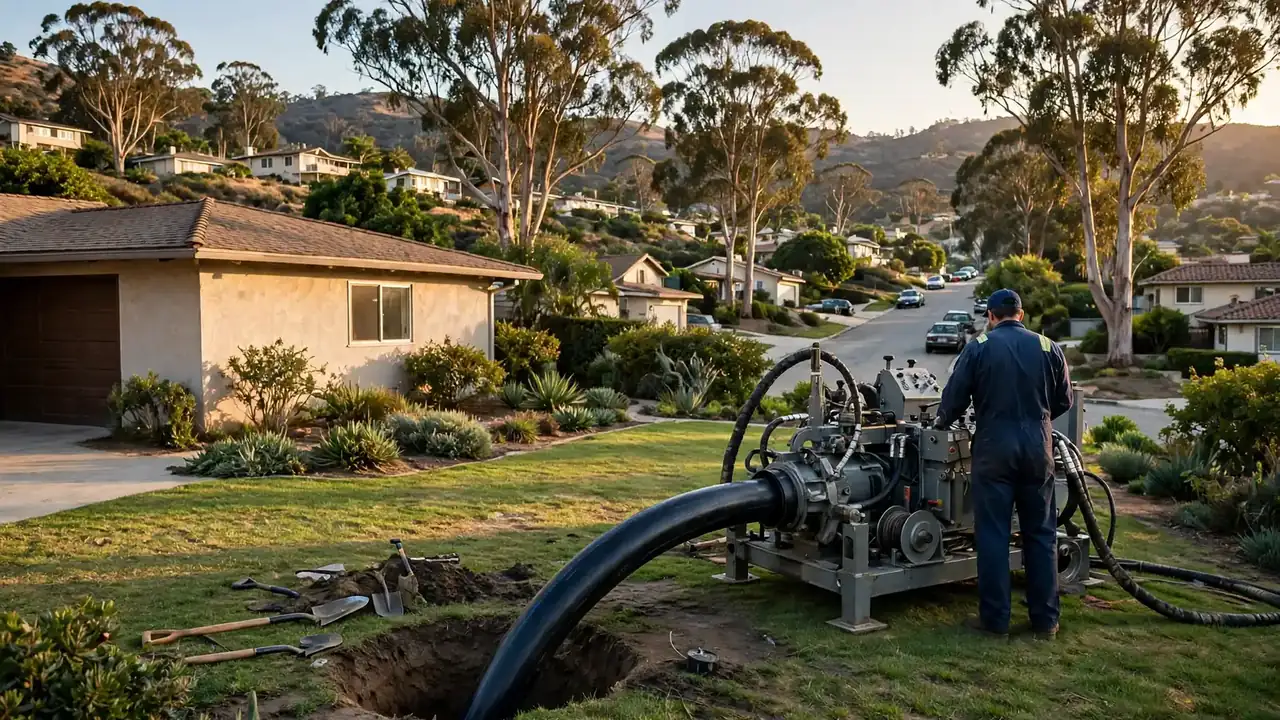
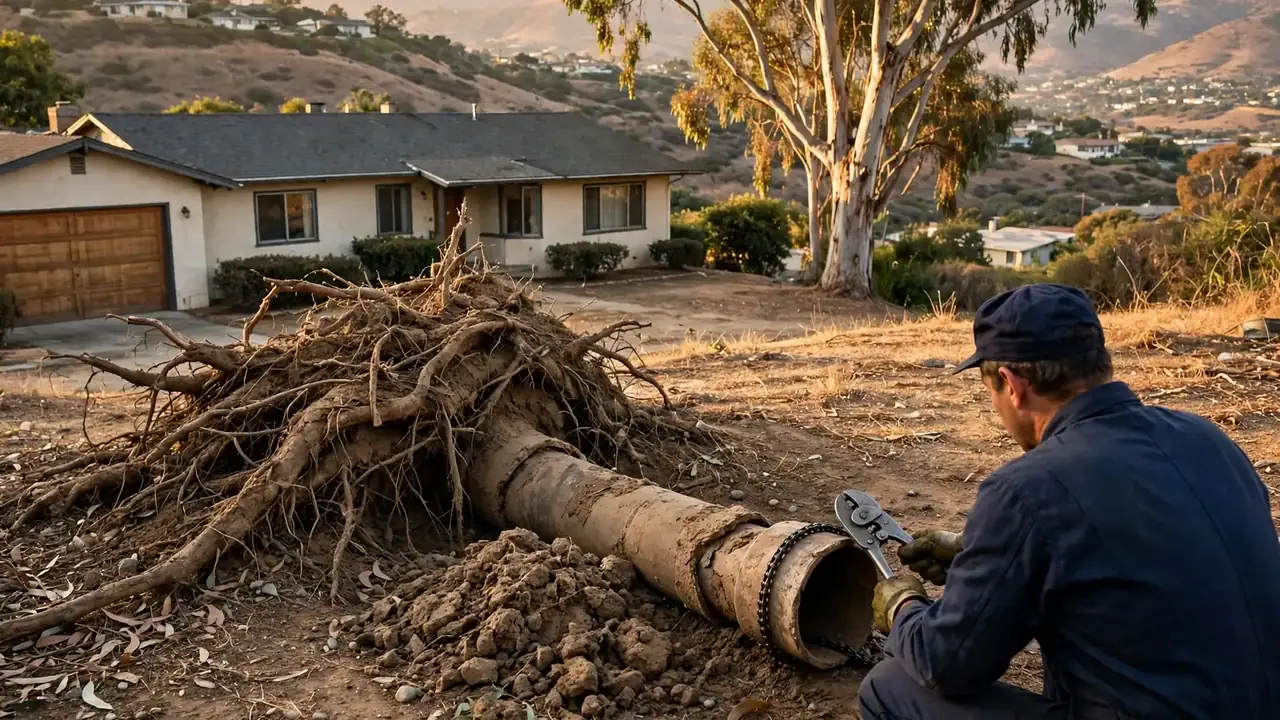
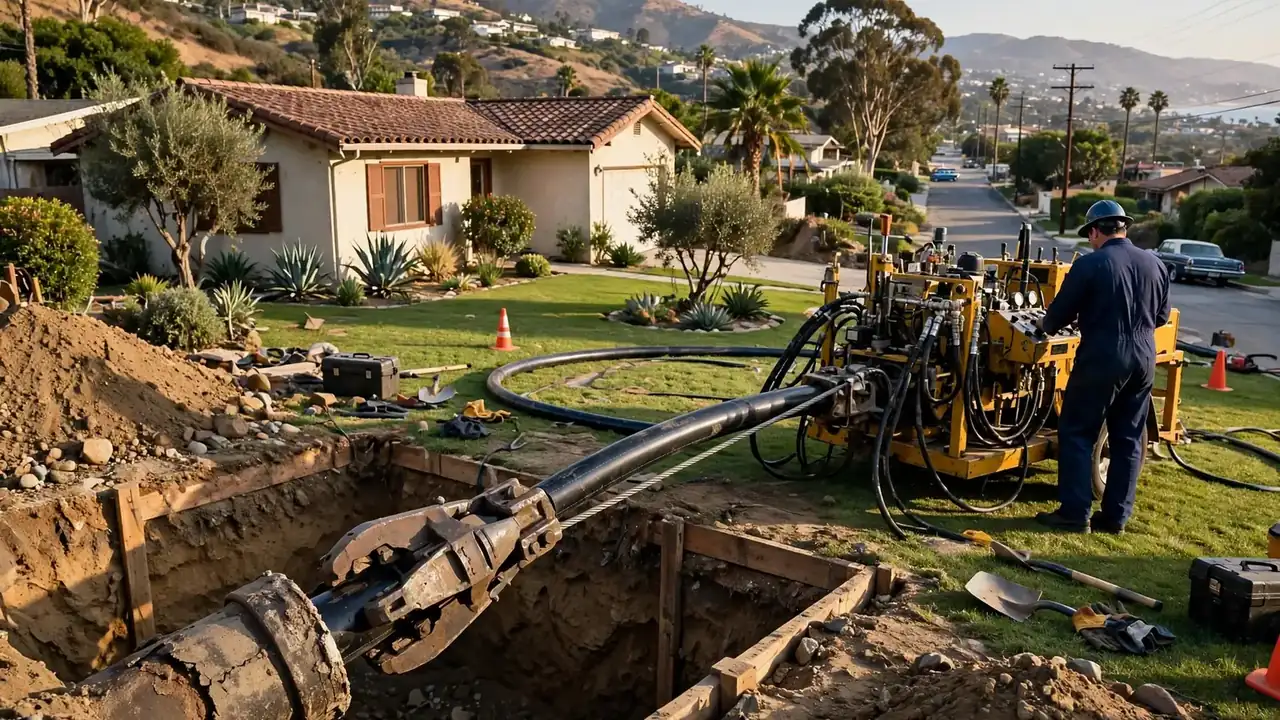
A line narrowed by grease, scale, and roots
A lateral that keeps backing up will not heal — the water keeps coming back through the lowest drain in the house.
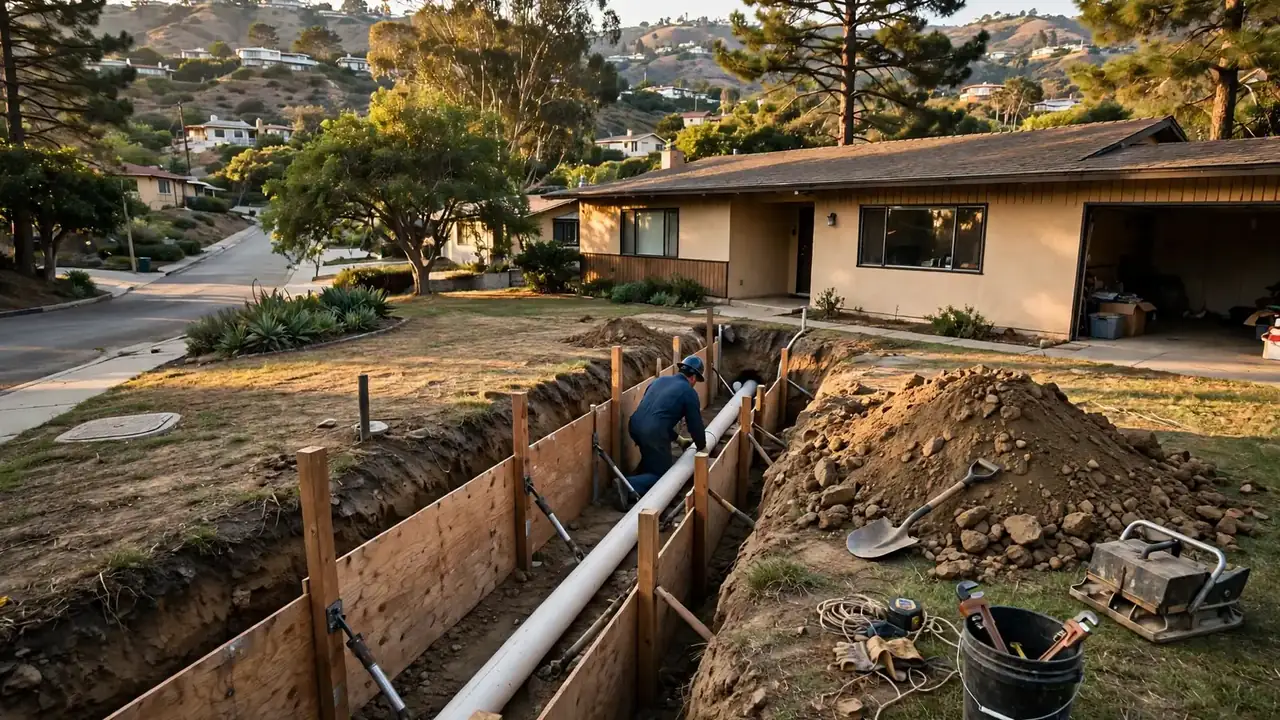
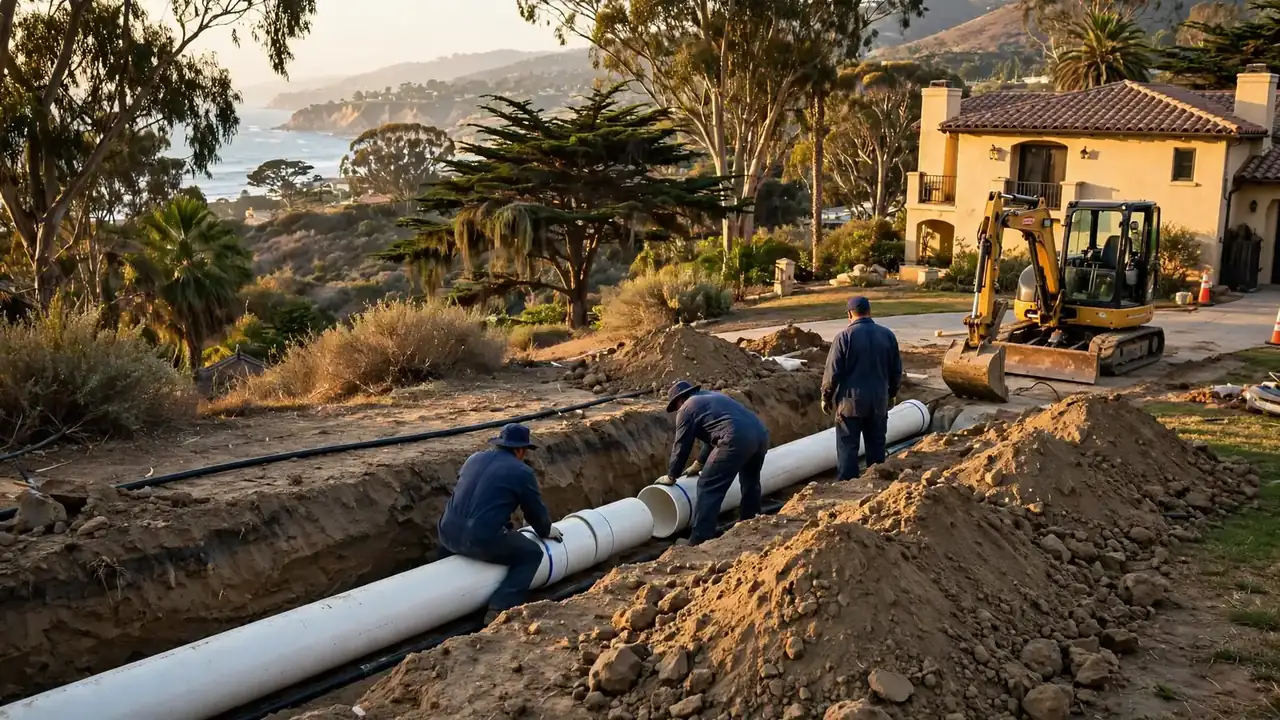
A line scoured clean to the street main
The work is checked with a camera, not a look at the surface — the new line is seen end to end before the job is called done.
Problems hydro jetting solves
- Grease and soap buildup that narrows the line and slows every drain.
- Root masses at clay tile joints that catch paper and waste.
- Scale inside old cast iron pipe that has narrowed the bore over decades.
- A blockage that a cable opened once, then came back.
- A line too dirty for a camera inspection to show the pipe.
- Slow drainage through the whole house from a dirty main line.
Signs your sewer line needs hydro jetting
- Drains are slow throughout the house, not just at one fixture.
- The line has been snaked before, and the problem came back within months.
- A gurgling sound comes from a toilet or tub when another fixture drains.
- Grease, soap, and hair have had years to build up inside the line.
- Roots have been found at the joints of a clay tile lateral.
- The lowest drain in the house backs up after heavy water use.
- A camera inspection shows buildup narrowing the pipe, but no collapse.
- The line needs clearing before a camera inspection can see the pipe.
Related services
Sewer Root Removal · Sewer Camera Inspection · Emergency Sewer Repair
Industries that use this service
Commercial Properties · HOA & Multi-Family · All industries →
Related guides
Old Pipes in Rancho Palos Verdes · Sewer Repair Insurance in California · All guides →
Frequently asked questions
Questions people ask about hydro jetting, answered plainly.
Hydro jetting cleans a sewer line with high-pressure water. A hose with a specially designed nozzle is fed into the line, and jets of water scour the pipe walls as the hose moves through, cutting away grease, scale, soap residue, and root masses, then flushing the debris downstream to the street main. The pipe ends up clean all the way around, not just open in the middle. The debris the jetting loosens is flushed downstream to the street main, so nothing is left in the line to catch the next load of wastewater. The camera inspection that usually follows shows the clean walls and the true condition of the pipe underneath the buildup.
Yes, when the pressure is set for the pipe. A clay tile line from the 1960s is jetted at a lower pressure than a newer plastic line, and the nozzle is chosen for the material. A line that is already collapsed or badly cracked is not jetted at all — it is camera-inspected first, and the structural problem is handled as a repair.
A snake punches a hole through a blockage so water can pass again, but it leaves the buildup on the pipe walls. Hydro jetting removes the buildup itself — the grease layer, the scale, the root mat — so the pipe is clean along its full length. That is why a line that keeps blocking after snaking often stays clear much longer after jetting. A cable is still the right tool for a quick opening when a line is blocked solid and the camera cannot get through, and the jetter often follows the cable to clean what the cable opened. The two tools work together: the cable opens the line, and the jetter cleans it.
There is no fixed schedule that fits every home. A line with a history of root problems is usually jetted when the symptoms return, and a camera inspection every two to three years shows whether buildup is returning. A home with heavy grease use in the kitchen may need it more often than a home where the line stays clear between inspections. A camera inspection every two to three years shows whether the buildup is returning and how fast. The inspection is the measure, and the jetting is the response. The two work together, and the schedule follows what the camera shows rather than a fixed calendar.
Yes. A root-cutting nozzle slices through root masses at clay tile joints and flushes the cuttings downstream. Jetting removes the roots that are inside the pipe, but it does not repair the joint the roots entered through. If the camera shows the same joints full of roots again, the joint itself needs a repair or a liner. The interval between clearings tells the homeowner how fast the roots are growing back. A line that blocks again in six months has joints that are wide open, while a line that stays clear for two years has joints that are only slightly open. The camera record shows the difference.
Yes. A descaling nozzle scours the hard scale that builds up inside old cast iron over decades, restoring the bore of the pipe. The camera after jetting shows how much scale is gone and whether the pipe wall underneath is sound. Scale removal is one of the jobs jetting does that a cable cannot do at all. The camera after jetting shows how much scale is gone and whether the pipe wall underneath is sound. A cast iron pipe that has lost much of its wall to corrosion may need a repair or a replacement rather than another cleaning, and the camera is what shows that.
The line is assessed first, so a collapsed or badly cracked pipe is found before the jetter goes in. If the line is blocked solid, the jetter itself does the clearing, working from the access point toward the street main. The crew also confirms the access point — a cleanout or a pulled toilet — before the hose goes in.
It depends on what was causing the problem. Grease and soap buildup stays gone until it builds up again, which takes time. Roots grow back into the same joints, so a line with root problems will need attention again — the interval depends on the trees and the condition of the joints. A camera inspection after jetting shows whether the pipe itself needs a repair to make the result last. Grease buildup returns at the rate the household puts grease down the drains, so a kitchen that keeps grease out of the sink will keep a jetted line clear longer. Roots return at the rate the tree grows, which no household habit changes. Only a repair to the joint changes that.
It depends on the length of the line, how severe the blockage is, whether the entry point is a cleanout or has to be created, and whether a camera run follows the jetting. A short line with a light buildup is the simplest case. A long line with a root mat or heavy scale takes longer, and the camera check after the work is part of the job, not an addition to it.
Sewer line trouble in your Rancho Palos Verdes home?
Call Now to reach a local sewer professional. Describe the problem, where it is, and what the line has been doing.
Call now for sewer line help
Tap Call Now to reach a local sewer professional. Tell them where the problem is, what the line has been doing, and whether wastewater is coming into the home.
Hours: Mon–Fri 7:00 AM–10:00 PM PT · Sat 8:00 AM–10:00 PM PT · Sun 7:00 AM–9:00 PM PT
Before you call
- Stop using water if the line is backing up.
- Keep people and pets away from any wastewater.
- Note which drains are slow, and which one backs up first.
- Note whether the problem happens in heavy rain, or all the time.
- Have the age of the home ready, if you know it.