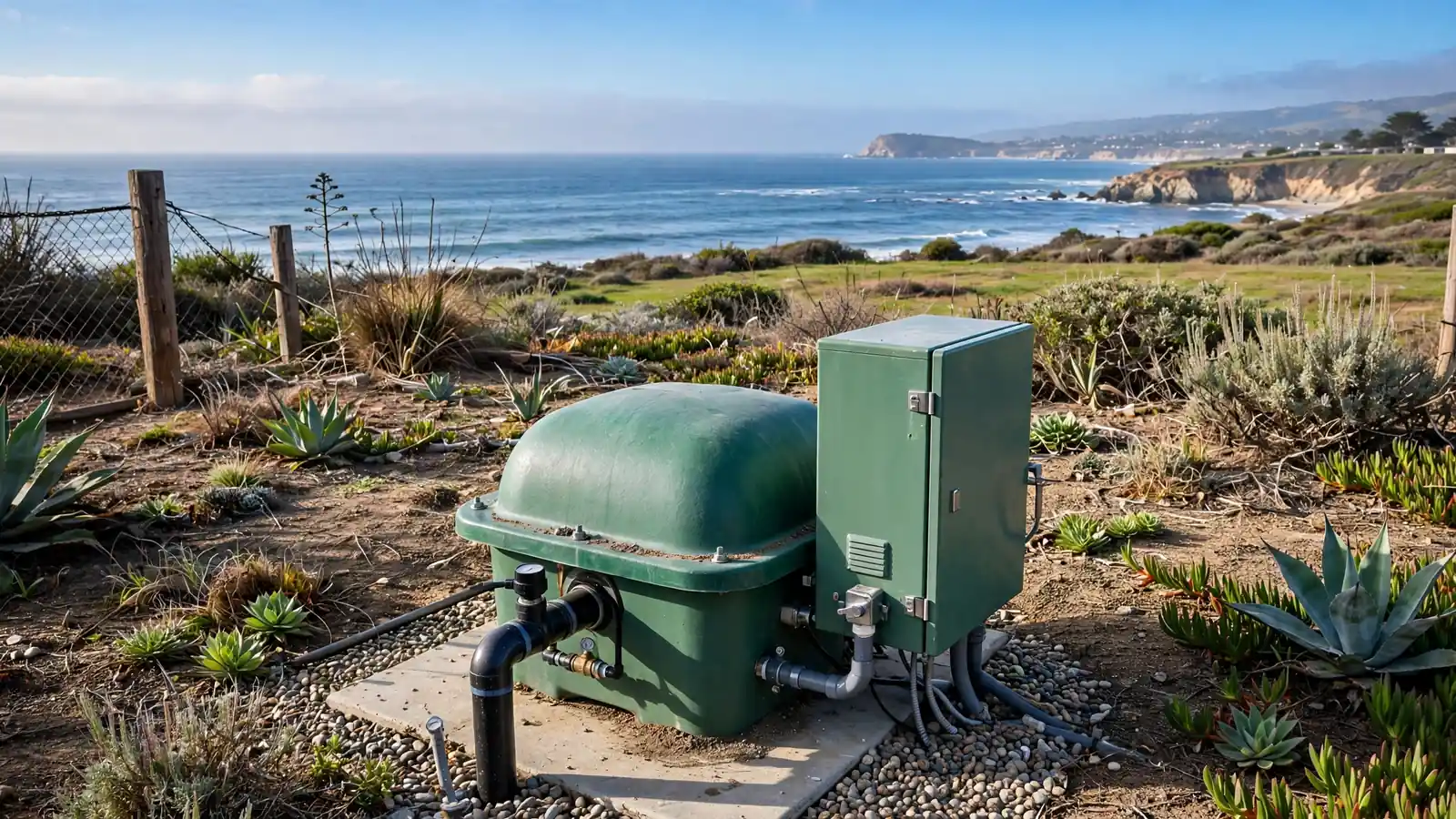
Abalone Cove Grinder Pumps & Sewer System in Rancho Palos Verdes, CA
Abalone Cove runs on the only sewer system in Rancho Palos Verdes that the City itself owns and operates — and its grinder pumps are the part homeowners deal with most.
Need help with your sewer line?
Call Now to reach a local sewer professional. Describe the problem, where it is, and what the line has been doing.
Hours: Mon–Fri 7:00 AM–10:00 PM PT · Sat 8:00 AM–10:00 PM PT · Sun 7:00 AM–9:00 PM PT
The only City-owned sewer system
The Abalone Cove Sewer System is the only system in the City of Rancho Palos Verdes that is owned, operated, and maintained by the City itself. Every other part of the public sewer system in the city belongs to the County Sanitation Districts or the LA County Consolidated Sewer Maintenance District. That distinction matters, because it decides who a homeowner calls, who maintains what, and who is responsible when something fails. A homeowner in Abalone Cove is on a City system. A homeowner anywhere else in Rancho Palos Verdes is on a County system, and the Abalone Cove rules do not apply there.
The system was installed in 2001 and came online in 2002, built to serve a coastal area where gravity sewer lines could not work on their own. It serves 111 lots, of which 64 are developed, and it is a low-pressure system: instead of wastewater flowing downhill by gravity alone, grinder pumps at the properties push wastewater into a network of low-pressure pipe, which carries it to lift stations and then to a force main and the wider system. The scale of the system is recorded in the City's own documents: 44 grinder pumps, 130 manholes, one diversion structure, about 19,000 linear feet of gravity pipe, 19,615 linear feet of low-pressure pipe, 2,505 linear feet of force main, and four lift stations.
The system's condition has been graded publicly. The City's 2013 Infrastructure Report Card graded the Abalone Cove system with a grade of D, a low mark that reflects the age of the system, the difficulty of maintaining a low-pressure network in a coastal landslide area, and the cost of bringing it up to a higher standard. A grade of D does not mean the system does not work. It means the system needs attention, and the homeowner who lives on it should understand how it works, what fails, and who to call when it does. The rest of this guide explains that, in homeowner terms.
How a low-pressure grinder pump system works
A grinder pump is a pump with a cutting mechanism that grinds wastewater and pushes it into the low-pressure pipe network. Each pump serves a property, and it sits in a tank or basin on that property, usually buried with only a lid and a control panel visible at the surface. When wastewater enters the tank, the level rises, the pump starts, the grinder breaks up solids, and the pump pushes the wastewater out through the low-pressure pipe. When the level falls, the pump stops. The cycle repeats all day, and the homeowner hears little of it — a hum when the pump runs, and silence when it does not.
The low-pressure pipe network is the part that makes the system different from a gravity sewer. In a gravity system, the pipe falls steadily toward the main, and the wastewater flows downhill. In Abalone Cove, the ground does not fall steadily toward the main, so the pipe cannot rely on gravity alone. The grinder pumps provide the pressure, and the low-pressure pipe carries the wastewater under pressure to the lift stations. The lift stations — four of them — collect the flow and push it on through the force main to the wider system. The diversion structure is part of that network, directing flow where it needs to go. The system is a chain, and a failure at any link in the chain affects the properties behind it.
The pumps in Abalone Cove are E-One low-pressure pumps, a widely used grinder pump design, and the City's maintenance of the system is handled by a sole-source maintenance contractor, Multi W. Systems. Sole-source means the City has one contractor for the maintenance of the system, rather than several, and that contractor is the one who knows the system, its pumps, and its history. A homeowner who needs maintenance on the City side of the system deals with the City and its contractor, not with a general plumber, and the distinction between the City side and the homeowner side is the first thing to get clear when something fails.
Who maintains what
The split between the City and the homeowner in Abalone Cove follows the system, not the property line. The City owns, operates, and maintains the Abalone Cove Sewer System itself: the low-pressure pipe network, the gravity pipe, the force main, the manholes, the diversion structure, and the lift stations. The City's contractor, Multi W. Systems, performs that maintenance under its contract with the City. A failure in the pipe network, a lift station problem, or a manhole problem is the City's to fix, and the homeowner reports it to the City.
The grinder pump on a property is the part the homeowner deals with most directly, and the responsibility for it depends on where it sits in the system and what the City's rules state for that property. The pump, its tank, its control panel, and its alarm are on the property, and the homeowner is the one who hears the alarm, sees the warning light, and notices when the pump runs too often or not at all. The homeowner should know where the pump is, where the control panel is, and what the alarm sounds like, because those are the tools for knowing when something is wrong. The City's documents and the property's own records state the maintenance split for the pump itself, and the homeowner should read them before a failure, not during one.
The practical rule is to call the City when the problem is in the shared system, and to get help for the pump and the drains inside the property when the problem is there. A backup that affects one house and no other is usually a pump or a lateral problem on that property. A problem that affects several houses at once is usually a network or lift station problem, and the City should be told at once, because the City is the only party that can fix it. A homeowner who is unsure which it is should describe what is happening — which drains are affected, whether the pump alarm is sounding, whether the neighbours have the same problem — and the City can tell the homeowner which side of the split the problem falls on.
What to do when your E-One pump fails
The first sign of a pump failure is usually the alarm. The control panel has an alarm — a light, a sound, or both — that goes off when the water level in the tank rises too high, which means the pump is not moving wastewater out. When the alarm sounds, the household should stop using water at once: no flushing, no showers, no laundry, no dishwashing. Every gallon that goes down a drain has to go into a tank whose pump is not working, and the tank will fill and back up into the house if water use continues. Keep people and pets away from any wastewater that has already backed up, and do not use a drain cleaner, which will not fix a pump and can make the work harder and less safe.
The next step is to find out whether the pump has power and whether the problem is the pump itself. Check the control panel for a tripped breaker or a switch that has been turned off, and check whether the property has power at all. A pump that has no power cannot run, and a tripped breaker is a simple fix. A pump that has power, has its alarm sounding, and still does not run is a pump that needs help, and the homeowner should call for it. Describe the alarm, the panel, and what the pump is doing — or not doing — so the person who responds knows what to bring. The pump model is an E-One low-pressure pump, and that detail helps, because the parts and the service for it are specific to the design.
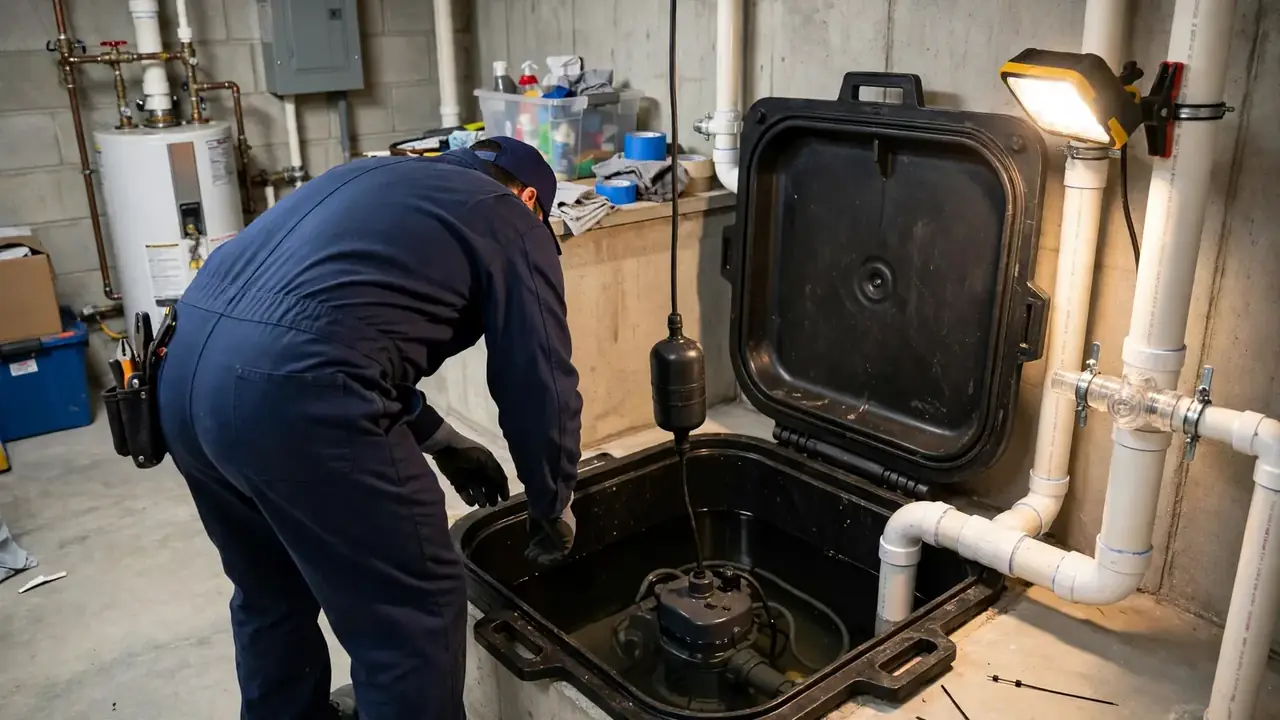
The pump should not be opened by the homeowner. The tank holds wastewater, the pump has a cutting mechanism, and the control panel carries power. The work belongs to someone who knows the pump and the system, and the City's maintenance contractor is the party that knows this system. A homeowner who opens the tank risks injury and risks damaging the pump further, and the repair will take longer for it. Stop the water, note the alarm and the panel, call for help, and keep the record: when the alarm sounded, what was happening in the house, and what the panel showed. That record is useful for the person who fixes the pump, and for the City if the failure turns out to be part of a wider system problem.
Lift stations, manholes, and the pipe network explained
The four lift stations are the workhorses of the Abalone Cove system. Each one collects wastewater from the low-pressure network and pushes it on through the force main, and each one has pumps, controls, and an alarm of its own. A lift station that fails affects every property behind it, and the City monitors them for that reason. A homeowner will rarely see a lift station up close — they are City facilities, fenced and signed — but the homeowner will feel one fail, because the flow from the whole area behind it stops, and the grinder pumps on the properties start alarming one after another. A cluster of alarms across several houses is the signal of a lift station or network problem, and it should be reported to the City at once.
The 130 manholes are access points on the gravity pipe and the wider network, and they are how the City inspects and maintains the pipe. A manhole that is damaged, sunken, or overflowing is a City problem, and it should be reported to the City. The diversion structure is a single structure that directs flow within the network, and it is also a City facility. The gravity pipe — about 19,000 linear feet of it — carries flow by gravity where the ground allows, and the low-pressure pipe — 19,615 linear feet — carries flow under pressure where it does not. The force main — 2,505 linear feet — carries flow under pressure from the lift stations onward. The numbers describe a system that is mostly pipe, with a small number of pumps and stations doing the work of moving the flow through it.
The network is in a coastal landslide area, and that location is part of its maintenance story. Ground movement can shift pipe, open joints, and stress the connections, and the low-pressure design means a leak or a break does not always show as a surface puddle the way a gravity leak does. The City's 2013 grade of D reflects that difficulty, and the homeowner should understand that the system needs watching. A homeowner who notices a wet patch, a smell, or a sunken area above the pipe network should report it to the City, because the City is the party that can inspect the network and find the cause. The homeowner's own pump alarm is the warning for the property. The wet patch or the smell is the warning for the network.
Living on the Abalone Cove system
Living on the Abalone Cove system means living with a pump, and the habits that keep a grinder pump working are simple. Do not flush wipes, even those labelled flushable, because wipes do not break down the way paper does, and they wrap around the grinder and stop it. Do not pour grease down the drain, because grease hardens in the tank and the pipe and narrows them. Do not flush anything that is not meant to be flushed — dental floss, cotton, sanitary products, and other items that do not break down will jam the grinder or block the pipe. The pump is designed for wastewater and toilet paper, and everything else is a risk to it.
The pump should be checked on a schedule, and the homeowner should know when it was last checked and what was found. A pump that runs too often, runs too long, or runs loudly is a pump that is struggling, and the struggle is usually caused by something in the tank or the pipe — a partial blockage, a worn cutter, or a control that is not switching correctly. A check that finds the problem early is a repair. A check that never happens is a failure during a holiday or a storm, when help is hardest to reach. The control panel should be checked too: the alarm should be tested, the light should work, and the homeowner should know what the alarm sounds like before it goes off in earnest.
The system serves 111 lots and 64 developed properties, and the homeowner is part of a small community on a shared system. A problem that affects one house is one house's problem. A problem that affects several houses is the community's problem, and the City should hear about it at once. The homeowner who reports a network problem early helps every property on the system, and the homeowner who keeps the pump maintained helps the network too, because a pump that pushes correctly does not strain the lift stations behind it. The Abalone Cove system is the City's system, and the homeowners on it are the people who live with it every day. Knowing how it works, what fails, and who to call is the way to live with it well.
Services for this situation
Related guides
 Sewage Backup in the Lowest Drain
Wastewater coming up through the lowest drain is an urgent problem. Stop using water, keep away from the wastewater, and call for ...
 Signs Your Sewer Line Is Failing
Most Rancho Palos Verdes laterals were laid decades ago in clay, cast iron, or bituminous fiber. These are the signs that yours is...
 What to Have Ready Before Sewer Repair
A little preparation before sewer repair saves time on site and helps the crew find the cause faster. Here is what to have ready: ...
Frequently asked questions
Questions people ask about abalone cove grinder pumps, answered plainly.
It is the only sewer system in the City of Rancho Palos Verdes owned, operated, and maintained by the City itself. It was installed in 2001, came online in 2002, and serves 111 lots, of which 64 are developed. Every other part of the public system in the city belongs to the County.
A grinder pump grinds wastewater and pushes it into a low-pressure pipe network. Abalone Cove uses them because the ground does not fall steadily toward the main, so gravity alone cannot carry the flow. The pumps provide the pressure, and the low-pressure pipe carries the wastewater to the lift stations.
Stop using water at once — no flushing, no showers, no laundry, no dishwashing — and keep people and pets away from any wastewater that has backed up. Check whether the pump has power and whether a breaker has tripped, then call for help and describe the alarm and the panel.
The City owns, operates, and maintains the system, and its sole-source maintenance contractor is Multi W. Systems. The City maintains the pipe network, the force main, the manholes, the diversion structure, and the lift stations. The homeowner deals with the pump and the drains on the property.
There are four lift stations. Each collects wastewater from the low-pressure network and pushes it on through the force main. A lift station failure affects every property behind it, so a cluster of pump alarms across several houses should be reported to the City at once.
The City's 2013 Infrastructure Report Card gave it that mark because the network was aging, hard to maintain in a coastal landslide area, and expensive to bring up to a higher standard. The mark flags a system that needs steady attention, not one that has stopped working.
Do not flush wipes, even those labelled flushable, and do not pour grease down the drain. Wipes wrap around the grinder and stop it, and grease hardens in the tank and the pipe. The pump is designed for wastewater and toilet paper, and everything else is a risk to it.
It is a small network with a lot of pipe in it. The count from City records runs to four lift stations, one diversion structure, and 130 manholes, plus 44 grinder pumps across the properties. Pipework adds up to around 19,000 feet of gravity line, 19,615 feet of low-pressure line, and 2,505 feet of force main, all serving 111 lots, 64 of them developed.
Sewer line trouble in your Rancho Palos Verdes home?
Call Now to reach a local sewer professional. Describe the problem, where it is, and what the line has been doing.
Call now for sewer line help
Tap Call Now to reach a local sewer professional. Tell them where the problem is, what the line has been doing, and whether wastewater is coming into the home.
Hours: Mon–Fri 7:00 AM–10:00 PM PT · Sat 8:00 AM–10:00 PM PT · Sun 7:00 AM–9:00 PM PT
Before you call
- Stop using water if the line is backing up.
- Keep people and pets away from any wastewater.
- Note which drains are slow, and which one backs up first.
- Note whether the problem happens in heavy rain, or all the time.
- Have the age of the home ready, if you know it.