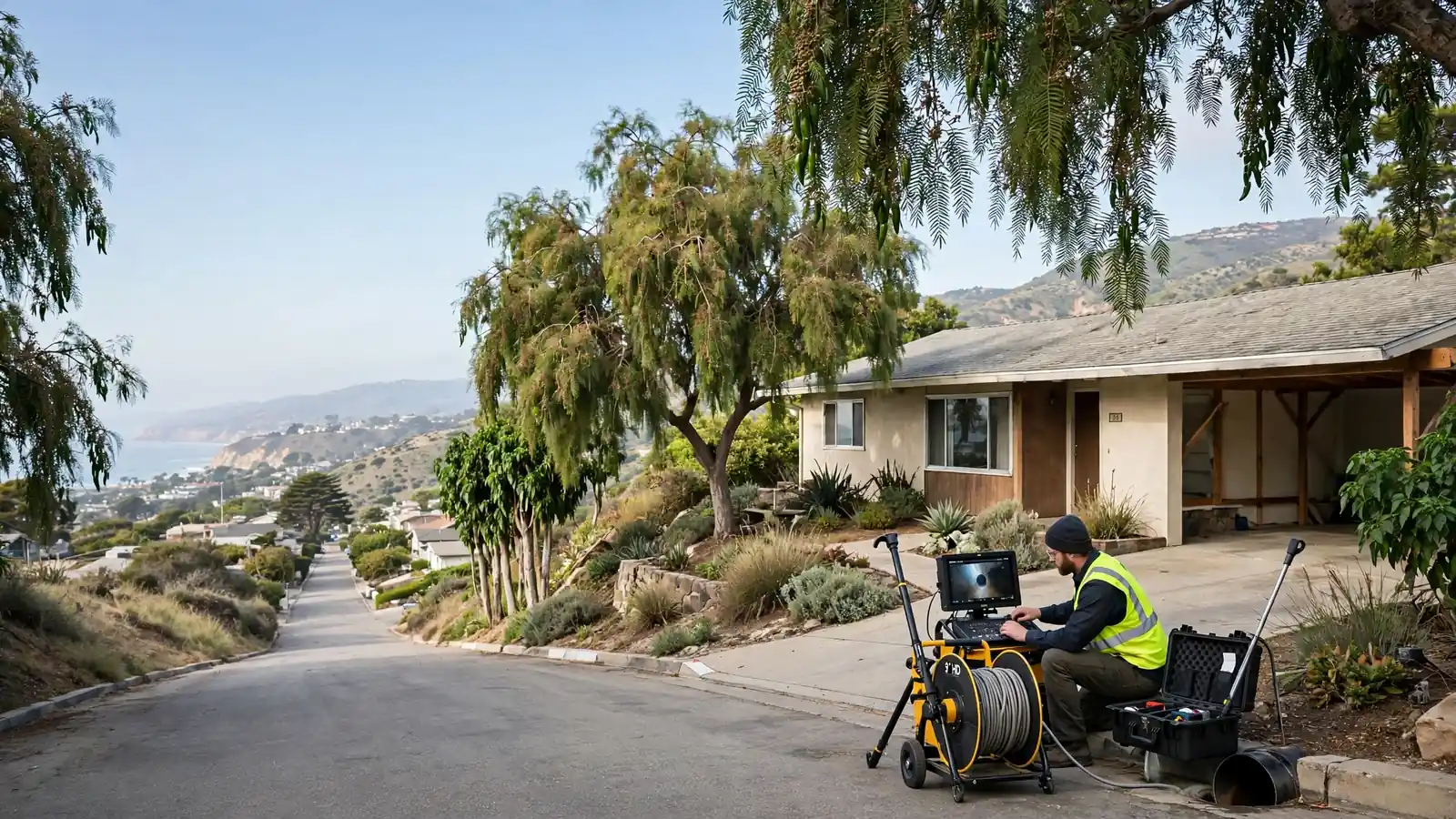
Sewer Inspection When Buying or Selling a Home in Rancho Palos Verdes, CA
A Rancho Palos Verdes home can look sound above ground and carry a failing sewer lateral below it. A camera inspection before the sale closes is how a buyer finds out.
Need help with your sewer line?
Call Now to reach a local sewer professional. Describe the problem, where it is, and what the line has been doing.
Hours: Mon–Fri 7:00 AM–10:00 PM PT · Sat 8:00 AM–10:00 PM PT · Sun 7:00 AM–9:00 PM PT
The City 10-year transfer rule
The City of Rancho Palos Verdes recommends a lateral inspection and repair on transfer of ownership if no inspection or replacement has taken place in the prior ten years. That recommendation is the City's own guidance, published on its sewers page, and it exists because the city's housing stock is old: the median Rancho Palos Verdes home was built in 1967, and more than eight in ten homes were built before 1980. A lateral laid when the house was built is now decades old, and ten years is a long time for a clay or cast iron line to go unlooked at. The recommendation is not a City order to replace the line, and it is not a condition of the sale by itself, but it is the City telling buyers and sellers what the pipe stock needs.
The same City guidance ties a lateral inspection to building permits. On issuance of a building permit of fifty thousand dollars or more, the City recommends the lateral be inspected and repaired where needed. A buyer who plans a remodel after purchase should know that rule before the purchase closes, because the remodel permit and the lateral inspection arrive together. A seller who has had recent permitted work done should know whether the lateral was looked at as part of it. The permit threshold is a trigger for a conversation about the lateral, and the camera inspection is the way to have that conversation with evidence rather than with assumptions.
The ten-year rule is also a practical timetable for a buyer. If the seller can show a camera inspection or a replacement from within the last ten years, the buyer has a record to read. If the seller cannot show one, the buyer is looking at a lateral whose condition is unknown, and the inspection is the step that turns the unknown into a known. The footage and the written findings become part of the purchase file, and they are useful long after the sale: for the next inspection, for any later work on the line, and for an insurer who asks about the sewer. Escrow timing matters for the scope. The inspection should be ordered early in the contingency period, so the footage arrives while the buyer still has time to act on it, and the seller still has time to respond. A scope ordered late in escrow leaves no time for a repair, a credit, or a renegotiation, and the buyer is left choosing between closing on an unknown lateral or delaying the sale. The agent should put the scope on the calendar at the start of escrow, alongside the general inspection and the appraisal, so the lateral is known before the deadlines arrive.
What a camera scope shows before purchase
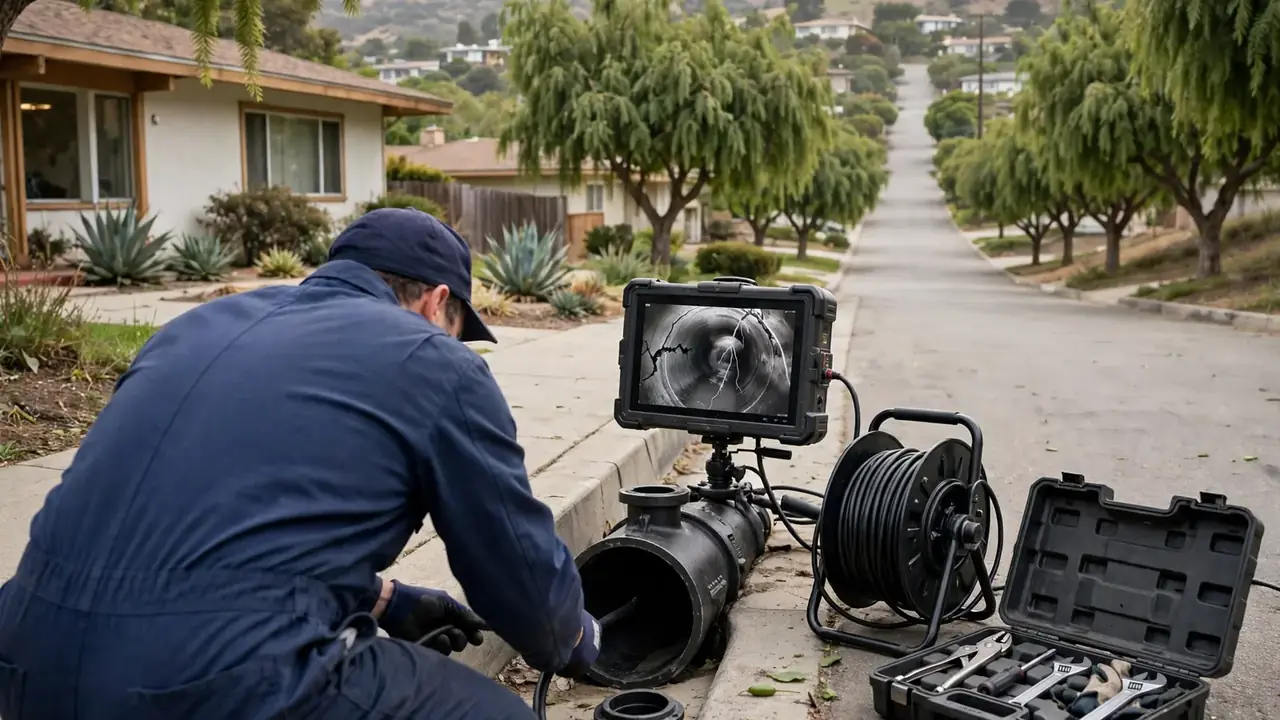
A sewer camera inspection, often called a scope, runs a small camera on a cable through the lateral from the house to the street main. The operator watches the inside of the pipe on a monitor and records the footage, noting the pipe material section by section, every joint, every crack, every root, every belly, and the connection at the street main. The locator marks the line's path and the position of each defect on the surface, with the depth. The buyer gets the footage and a written account of what it shows, and that account is the basis for any decision about the lateral.
The scope shows what a general home inspection cannot show. A home inspector walks the house, runs the taps, and notes slow drains, but the inspector does not see inside the buried lateral. A lateral at the end of its life may show no symptom at all: the drains work, the yard is dry, and the first backup comes after the purchase. The scope shows the clay joints that have opened, the cast iron that has corroded and narrowed, the roots that have entered through the joints, and the bellies where the ground has settled. It also shows what is sound, and a sound lateral is useful information too, because it tells the buyer the sewer is not a hidden problem.
The scope should cover the whole lateral, from the house to the street main, including the connection at the main. A scope that stops halfway leaves the second half unknown, and the second half is often where the worst damage is, because it is the oldest and deepest part of the line. The buyer should ask for the footage itself, not only a summary, and should ask whether the scope reached the street main. The footage is the record of the lateral's condition at the time of purchase, and it is the record the buyer will compare against any later inspection. The locator marks are part of the record the buyer should keep. Each defect the camera finds is marked on the surface with paint or a flag, with the depth noted, and those marks show where the problems are and how deep they sit. A buyer who photographs the marks has a map of the lateral condition that the footage alone does not give, because the footage shows the inside of the pipe and the marks show where that inside sits under the yard. The map is useful for any later work, and for a contractor who needs to find a defect without running the camera again.
What the footage means for the purchase
Footage that shows a sound lateral is a clear result: the pipe holds its shape, the joints are sealed, the bore is open, and the connection at the main is sound. The buyer moves in knowing the sewer is not a hidden problem, and the footage goes into the file for the next inspection. Footage that shows a lateral with a few open joints and light root intrusion is a different result: the line works, but it needs attention, and the buyer and seller can discuss whether the work happens before the sale closes or after, and who arranges it. Footage that shows a collapse, a deep belly, or roots through many joints is a third result: the line needs a repair or a replacement, and the purchase should deal with it the way it would deal with a roof or a furnace at the end of its life.
The way the purchase deals with a failing lateral depends on the sale, and there is no single right answer. Some buyers ask the seller to repair or replace the line before closing. Some buyers take a credit and arrange the work after closing. Some buyers walk away, because the lateral is one problem too many on top of other work the house needs. What matters is that the decision is made with the footage in front of everyone, rather than discovered after the purchase. A lateral that has been inspected is a known quantity in the negotiation, and a lateral that has not been inspected is a guess that usually turns out to be expensive.
The footage also matters for the lender and the insurer. A lender may ask about the condition of the sewer on an older home, and an insurer may ask about it when the policy is written. The footage and the written findings answer those questions with evidence. A buyer who has the footage can show it. A buyer who does not have it can only describe what the drains looked like on the day of the inspection, and that description is worth very little. A credit and a repair are different answers to the same footage. A repair before closing leaves the buyer with a fixed lateral and the seller with the work to arrange. A credit leaves the buyer with the money and the work to arrange after closing, and the buyer should confirm that the credit covers the work the camera showed, not only part of it. Either answer can work, and the choice depends on the sale, the timing, and the parties. What does not work is closing without an answer, because the lateral will still need the work after closing, and the money for it will have to come from somewhere. The scope is a small step in a large purchase, and it protects a large part of the purchase: the pipe that carries every drain in the house to the street.
Selling a Rancho Palos Verdes home: the lateral as a selling point
A seller who has a recent scope or a recent replacement has something useful to show a buyer: a lateral whose condition is known, with footage to prove it. In a city where more than eight in ten homes were built before 1980, a known lateral is a real point in a home's favour, because the buyer is already wondering about the pipe under the yard. A seller who can show a sound lateral, or a new lateral with footage of the finished line, takes a question off the table before the buyer asks it, and the sale moves more smoothly for it.
A seller who has not had the lateral looked at should consider a scope before listing. The scope shows the condition of the line, and the seller can decide what to do with what it shows: repair a local failure, line a line that still holds its shape, or disclose the condition and price the home accordingly. A seller who discloses a known lateral problem and prices for it is in a stronger position than a seller whose buyer discovers the problem during escrow, because a problem discovered during escrow reopens the negotiation at the worst possible time, when the buyer has already spent money on inspections and the seller has already spent time on the market.
The disclosure rules for a sewer lateral follow the same principle as the disclosure rules for anything else in the house: what the seller knows, the seller should disclose. A seller who has had backups, who has had the line cleared repeatedly, or who has a scope showing a failing lateral knows something about the house that the buyer needs to know. The scope and the written findings are the way to disclose it with evidence, and the buyer who receives them can make a decision with the full picture. A lateral that is disclosed is a problem that can be dealt with. A lateral that is hidden is a dispute waiting to happen. Disclosure forms are where the lateral belongs. A seller who has had backups, repeated clearings, or a scope showing a failing lateral should state that on the disclosure, with the dates and the records attached. A disclosure that omits a known lateral problem is a disclosure that can be challenged after the sale, and the challenge will cost more than the disclosure would have. A seller who discloses fully, with the footage and the findings attached, gives the buyer the information the buyer needs, and the sale that follows is a sale without a hidden sewer problem waiting to surface.
After the purchase: what to do with the footage
The buyer who has the footage should keep it, and should keep the written findings with it. The footage is the record of the lateral's condition at the time of purchase, and it is the baseline for every later inspection. A later inspection compared against the purchase footage shows whether the line is stable or getting worse, and whether the roots have returned, the joints have opened further, or a belly has deepened. Without the baseline, a later inspection can only show the condition on that day, and the change over time is lost.
The new owner should know where the lateral runs, where the cleanout is, and where the connection at the street main sits. The locator markings from the scope show the path, and the owner should keep that map with the footage. The owner should also know the pipe material, because the material decides how the line is maintained: a clay lateral with sealed joints needs watching for roots, a cast iron lateral needs watching for corrosion, and a lined or replaced lateral needs a check every few years to confirm it is holding. The purchase footage answers all of those questions, and the owner who has it does not have to guess.
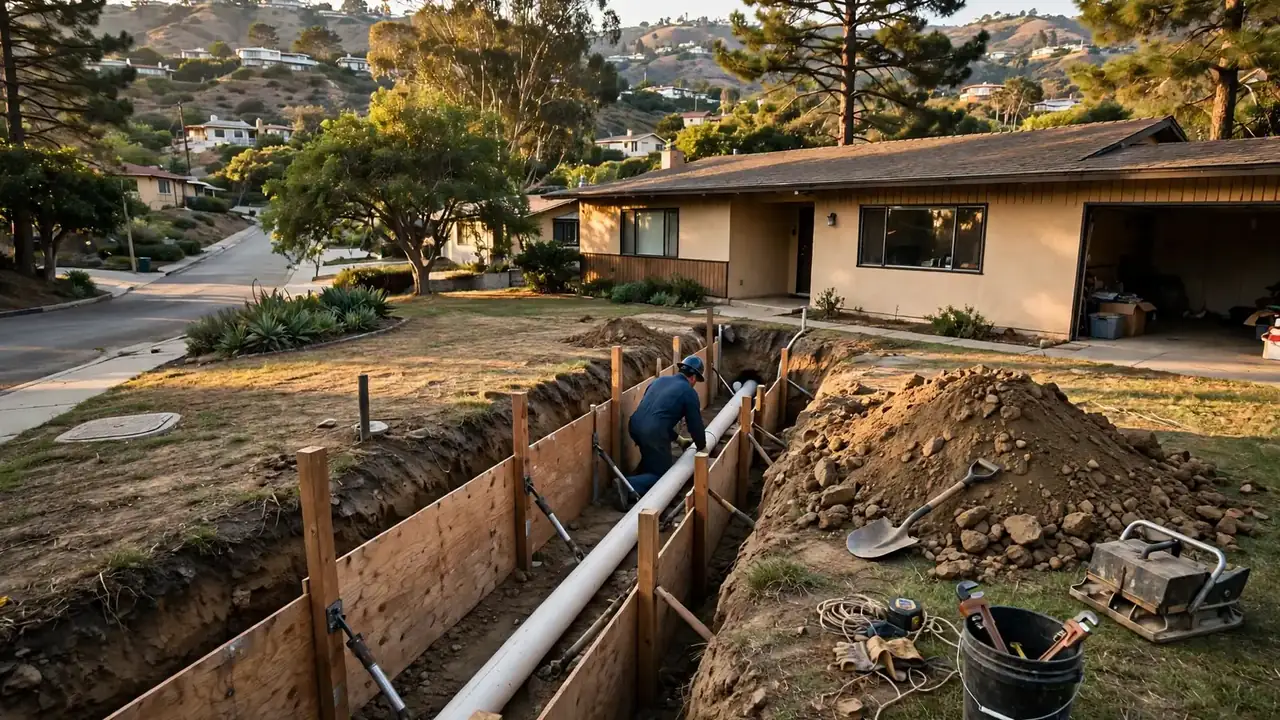
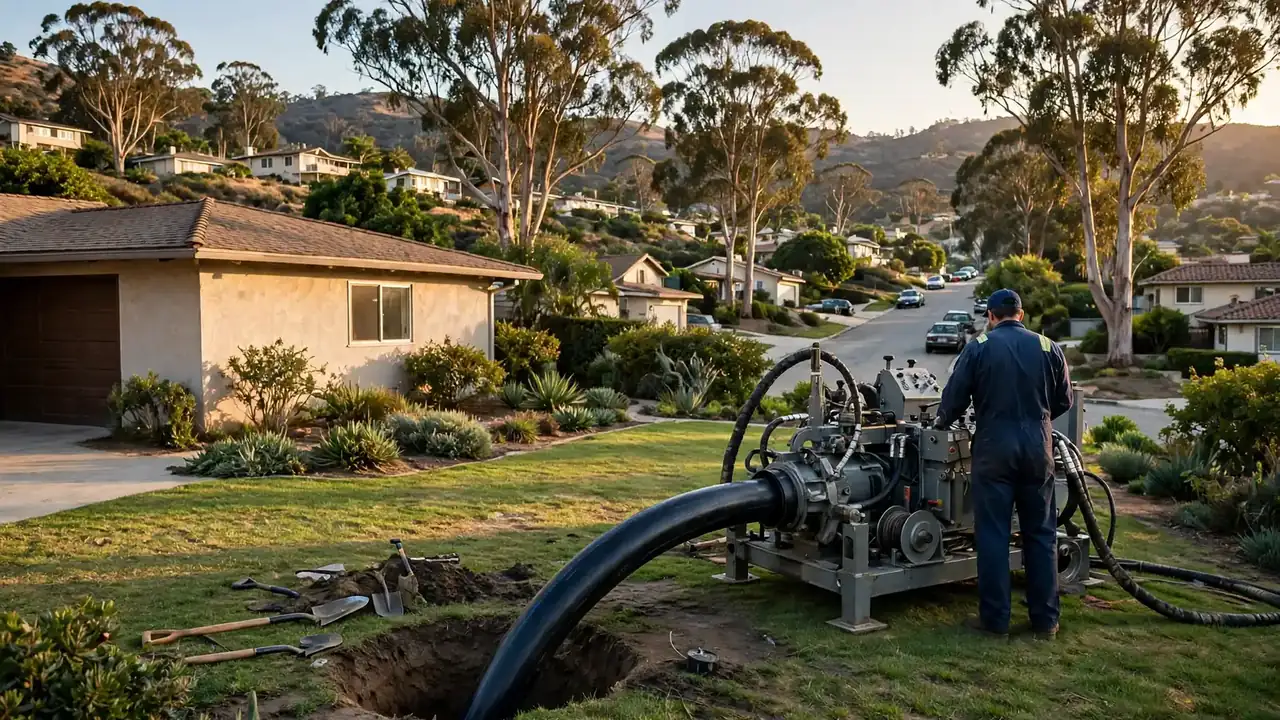
A new owner who inherits a lateral that needs work should plan it before it becomes a backup. A lining job, a bursting job, or a replacement can be scheduled, budgeted, and planned around the household, while a backup is decided under pressure, with water in the house and the clock running. The purchase footage shows which job is needed, and the owner can get the work done on a timetable that suits the household rather than on the timetable of a failure. The sewer is the least visible part of a Rancho Palos Verdes home, and the purchase scope is the step that makes it visible. A first-year inspection is a sensible step for a new owner. Twelve months after the purchase, a camera run compared against the purchase footage shows whether the line is stable or whether the move-in period, with its heavier water use, its new routines, and its first rainy season, has changed anything. A line that is stable after a year is a line the owner can watch on a longer interval. A line that has changed is a line that needs attention while the change is still small, and the owner who catches it in the first year catches it before it becomes a backup.
Services for buying or selling a home
Where we work
Eastview · Miraleste · West Palos Verdes · Los Verdes · Monaco · La Cresta · Del Cerro · Mesa Palos Verdes · Mira Catalina · Ladera Linda · Crestridge · Seaview · Portuguese Bend · Abalone Cove · Island View
Services used most
Sewer Camera Inspection · Sewer Lateral Repair · Trenchless Sewer Repair · Sewer Line Replacement
Frequently asked questions
Questions people ask about sewer lines in buying or selling a home, answered plainly.
Yes. The median home in the city was built in 1967, and more than eight in ten homes were built before 1980, so the lateral is often as old as the house. A scope shows the condition of the line before the purchase is final, and a failing lateral may show no symptom at all until it backs up after the purchase.
When a home changes hands, the City advises having the lateral looked at and fixed where needed if a decade has passed with no inspection or replacement. It is guidance rather than an order, and it reflects how old the pipe stock is: most laterals here are as old as the houses above them.
The whole lateral, from the house to the street main, including the connection at the main. It shows the pipe material section by section, every joint, crack, root, and belly, and the locator marks each defect on the surface with its depth.
The buyer and seller deal with it as part of the purchase, the way they would deal with a roof or a furnace at the end of its life. Some sellers repair it before closing, some buyers take a credit and arrange the work after closing, and some buyers walk away. The footage lets everyone decide with evidence.
It usually helps the sale. Showing a buyer a recent recording, or footage of a new line, removes a worry before it is raised. If the recording shows trouble, the seller can fix it, disclose it, or price for it, rather than having the buyer uncover it mid-escrow, when a renegotiation hurts most.
Keep the footage and the written findings together. They are the baseline for every later inspection, and a later inspection compared against them shows whether the line is stable or getting worse. Keep the locator map too, so you know where the lateral runs.
Sewer line trouble in your Rancho Palos Verdes home or business?
Call Now to reach a local sewer professional. Describe the problem, where it is, and what the line has been doing.
Call now for sewer line help
Tap Call Now to reach a local sewer professional. Tell them where the problem is, what the line has been doing, and whether wastewater is coming into the home.
Hours: Mon–Fri 7:00 AM–10:00 PM PT · Sat 8:00 AM–10:00 PM PT · Sun 7:00 AM–9:00 PM PT
Before you call
- Stop using water if the line is backing up.
- Keep people and pets away from any wastewater.
- Note which drains are slow, and which one backs up first.
- Note whether the problem happens in heavy rain, or all the time.
- Have the age of the home ready, if you know it.