Portuguese Bend Landslide & Your Sewer Line in Rancho Palos Verdes, CA
Portuguese Bend is an active landslide, and its sewer lines live with that movement every day. Some things can be fixed there. Some cannot be fixed right now, and this guide says so plainly.
Need help with your sewer line?
Call Now to reach a local sewer professional. Describe the problem, where it is, and what the line has been doing.
Hours: Mon–Fri 7:00 AM–10:00 PM PT · Sat 8:00 AM–10:00 PM PT · Sun 7:00 AM–9:00 PM PT
An active landslide complex
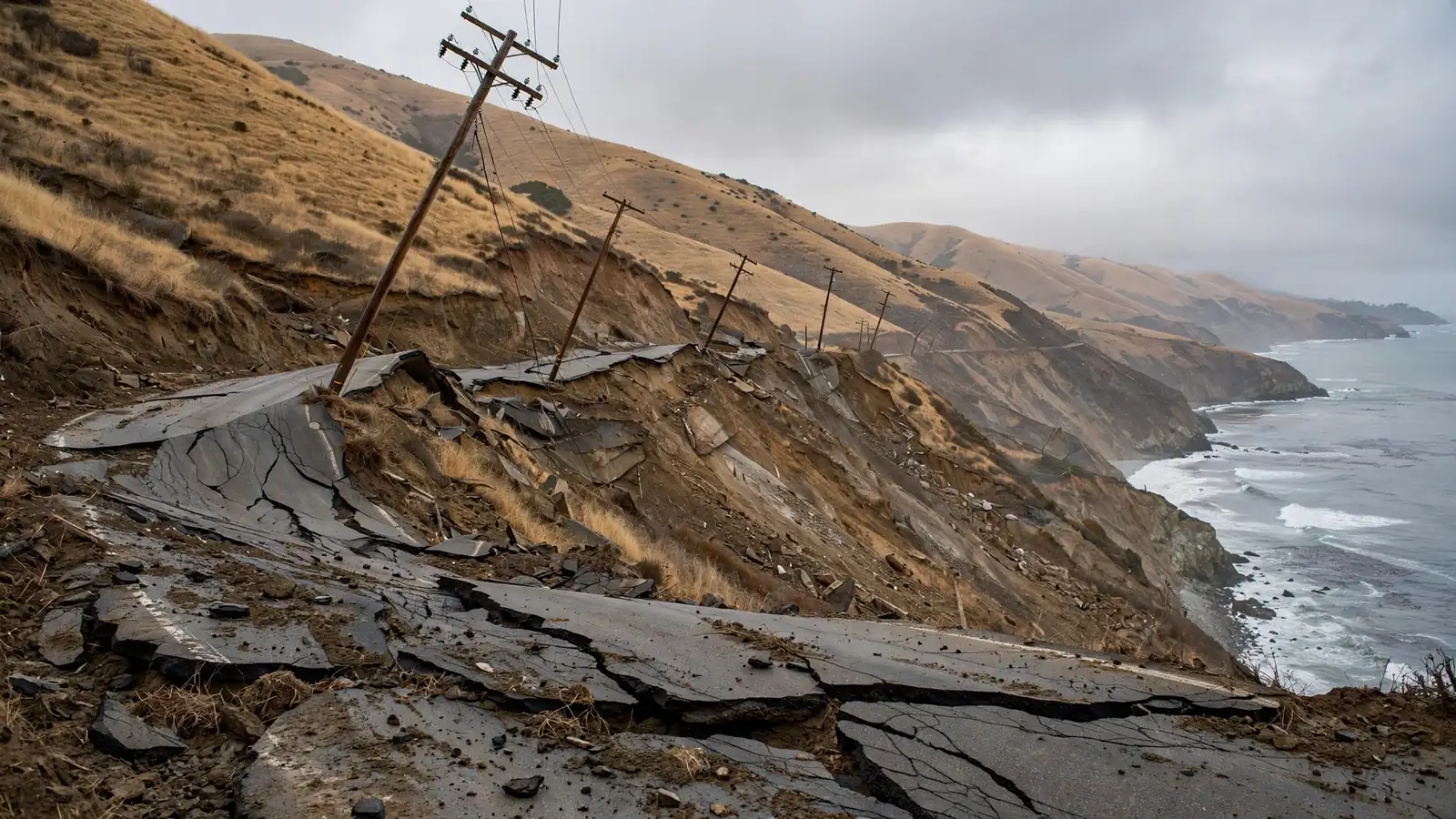
Portuguese Bend is an active landslide complex on the Palos Verdes Peninsula, part of the Ancient Altamira complex, and it reactivated in 1956. A landslide that reactivates does not settle back to stillness. It moves, it pauses, and it moves again, and the ground under the homes, the roads, and the utilities in the area moves with it. After the heavy rains of 2022 to 2024, the footprint of the movement grew from about 380 acres to about 700 acres, nearly doubling the area affected. The homes, the roads, and the sewer lines in that larger area are all living on ground that is moving, and the sewer work in Portuguese Bend has to be planned around that movement first, and around the pipe second.
The City declared a local emergency in October 2023, and that emergency has been renewed every 60 days. In September 2024, more than 200 homeowners were evacuated. Gas has been shut off in the area from August 2024, and the community was still without grid electricity as of November 5, 2026. Those facts describe a neighbourhood that is not operating normally, and a sewer line in that neighbourhood is not a normal sewer line. It is a line on moving ground, in an area without gas and without grid power, under an emergency declaration, and any plan for it has to start from those facts rather than from a standard repair scope.
Movement in the area slowed to about 0.8 inches per week by September 2026, after dewatering wells were installed, a reduction of about 92 percent from the faster movement before the wells. Slower is not stopped, and 0.8 inches per week is still movement: over a month, that is more than three inches, and over a year it is far more. A sewer pipe that moves three inches in a month will open joints, offset sections, and form bellies, and a pipe that moves that much in a year will fail. The slowing is real progress, and it is the reason the area is still habitable, but it does not make the ground stable, and no sewer repair in Portuguese Bend should be planned as if the ground were stable.
How utilities were built for moving ground
Utilities in Portuguese Bend were historically built above ground, in steel pipes with flexible couplings, because the engineers who built them understood that the ground moves. A buried pipe on moving ground is pulled apart at its joints. A pipe above ground, in steel, with couplings that flex, can move with the ground for a time without breaking. The flexible couplings absorb small movements, the steel resists the strain, and the pipe can be seen, inspected, and adjusted without digging. That design is a response to the landslide, and it is the reason the utility lines in the area look the way they do.
The above-ground design has limits, and the landslide has tested them. A flexible coupling can absorb a small movement, but it cannot absorb a large one, and a movement of several inches in a week will overwhelm a coupling that was designed for a slower rate. A steel pipe can resist strain, but it cannot resist a ground shift that pulls it in two directions at once. The above-ground lines are easier to inspect and repair than buried lines, and that is their strength, but they are not immune to the movement, and they need regular inspection to catch the strain before it becomes a break. A homeowner in Portuguese Bend should know where the lines on the property run, whether they are above ground or buried, and what the flexible couplings look like, because those are the parts that show the strain first.
The sewer system in the area includes both the private laterals that serve the homes and the public trunk lines that carry flow from the area onward, and the two have different owners and different problems. The private lateral is the owner's, and it moves with the ground under the house. The public trunk is the County Sanitation Districts' system, and it moves with the ground under the road. Both are affected by the same movement, and a failure in either one affects the homes behind it. The camera inspection of a private lateral shows the joints, the offsets, and the bellies on that property, and the public trunk has its own inspection and repair programme, which is described in the next section.
The LACSD trunk-line lining project
The Los Angeles County Sanitation Districts, known as LACSD, are lining the trunk sewer line through the area in a project that runs from July 2026 to March 2027. The project covers about 9,362 linear feet of trunk line and 13 manholes in Rancho Palos Verdes, as part of a larger project that includes about 11,334 linear feet and 25 manholes when the City of Los Angeles portion is counted. The work is a coating and lining rehabilitation: the inside of the trunk line is lined, and the manholes are rehabilitated, so that the trunk can keep carrying flow while the ground around it moves. Flow bypass is part of the project, with wastewater routed around the section being worked on, and traffic control on Palos Verdes Drive South was scheduled for November 16 to 25, 2026.
The lining project is a repair to the public trunk, not to the private laterals, and the distinction matters for a homeowner in Portuguese Bend. A lined trunk carries flow better than an unlined trunk, and it resists the movement better than a rigid pipe would, but it does not fix the private lateral that connects a house to that trunk. A homeowner whose lateral has opened joints, offset sections, or bellies still has a lateral problem after the trunk is lined, and the lateral still needs its own camera inspection and its own repair. The trunk project is good news for the area, and it is the largest sewer investment in the area in years, but it is not a fix for the private lines.
The project also shows the scale of the problem. A trunk line that needs lining along more than nine thousand feet, with thirteen manholes rehabilitated, is a trunk line that has lived through years of ground movement, and the lining is a response to that movement, not a routine renewal. The project runs through the winter of 2026 to 2027, and the work will be visible along Palos Verdes Drive South, with bypass pumping and traffic control. A homeowner in the area should expect disruption from the project, and should understand that the disruption is the price of keeping the trunk working while the ground moves. The private lateral work, by contrast, is smaller, quieter, and specific to each house, and it should be planned on its own timetable.
What breaks, and what the camera shows
A sewer lateral on moving ground fails in the ways that ground movement causes. Joints open, because each joint is a separate piece, and a small shift at one joint is enough to let roots in and let water out. Sections offset, because the ground under one section moves more than the ground under the next, and the pipe steps sideways at the joint. Bellies form, because the ground under a section settles and the pipe settles with it, and water and solids collect in the low spot. Cast iron corrodes and sags, clay cracks, and the whole line can lose its grade entirely, so that wastewater no longer flows to the main but sits in the pipe. The camera shows all of it: the open joints, the offsets, the bellies, the cracks, and the standing water, and the footage is the record of what the ground has done to the line.
The camera also shows what the ground has not yet done. A lateral that still holds its grade, with joints that are still sealed and a bore that is still open, is a lateral that is still working, even on moving ground, and the inspection that shows it is useful information. A lateral that has a few open joints and light root intrusion is a lateral that needs attention, and the attention can be planned. A lateral that has a collapse, a deep belly, or roots through many joints is a lateral that needs a repair or a replacement, and the repair has to be planned around the movement, not only around the pipe. A repair that ignores the movement will fail the same way the old line failed, because the ground will move the new pipe just as it moved the old one.
In Portuguese Bend, the interval between inspections should be tighter than in the rest of the city, because the ground here does not sit still long enough for a long interval to make sense. A fresh camera run belongs after every heavy rain, after any spell when the movement speeds up, and whenever the lot itself shows a change: a crack opening in a wall, a fence starting to lean, a hollow forming in the yard over the line, or a damp patch where the ground was dry. Each run is filed next to the one before it, and the comparison between runs is where the information lives, since it shows the joints opening wider, a low spot deepening, or a section holding steady. A homeowner who keeps that running comparison knows whether the pipe is keeping up with the ground or losing to it, and no single inspection on its own can give that answer.
What cannot be fixed right now
Some things in Portuguese Bend cannot be fixed right now, and it is important to say so plainly. A lateral on ground that is still moving cannot be given a permanent fix, because the ground will move the new pipe just as it moved the old one. A lining job that seals the joints will hold for a time, and then the ground will move again, and the liner will strain at the joints. A replacement that lays a new pipe at a correct grade will hold for a time, and then the ground will settle again, and the new pipe will form a belly. A repair in Portuguese Bend is a repair that buys time, not a repair that ends the problem, and the homeowner should understand that before authorising the work. The work is worth doing, because a working lateral is better than a failed one, but it is not a permanent solution while the ground is still moving.
The construction moratorium is the second limit. A moratorium covering about 715 acres took effect under Ordinance 692 in September 2025, and it restricts construction in the landslide area. A sewer repair that needs a permit, an excavation, or a new connection has to be planned within that moratorium, and the City is the source for what is allowed and what is not. A homeowner who plans a lateral replacement in the moratorium area should ask the City first, because the work may be limited, delayed, or conditioned in ways that a repair elsewhere in the city is not. The moratorium exists because the ground is moving, and the City is limiting the work that adds load or disturbance to that ground.
The third limit is the simplest: a home without gas and without grid electricity is a home where the household is already dealing with a great deal, and a sewer repair is one more disruption. The work should be planned around the household's situation, not around a standard schedule, and the crew should understand that the property may not have power for equipment, may not have water pressure as normal, and may be under an evacuation order or a warning. A homeowner in Portuguese Bend who is evacuated, or who is living without power, should deal with the sewer problem in the order that matters: stop the water, keep away from any backup, and call the City and the County for guidance on what can be done now and what has to wait until the ground and the services are stable.
Living with a sewer line in the landslide area
Living with a sewer line in Portuguese Bend means living with the ground, and the habits that help are the habits of watching. Watch the drains: slow drains, gurgling toilets, and backups in the lowest drain are the signs that the lateral is failing, and they should be reported and inspected promptly. Watch the ground: a new crack in a wall, a leaning fence, a dip in the yard above the line, or a wet patch where the ground was dry are signs that the ground has moved, and the lateral should be inspected after any of them. Watch the neighbours: a problem that affects several houses at once is a trunk or network problem, and the City and the County should hear about it at once, because the private lateral is not the whole story.
Keep the record. The camera footage of the lateral, the written findings, the permit, and the inspection records should be kept together, and each new inspection should be compared against the last. The comparison shows whether the line is stable or still moving, and whether the repair that was done is holding or failing. The record is also useful for the City, for the County, and for any future buyer, because the history of the lateral is part of the history of the house, and a house in a landslide area has a history that matters more than most.
The most important thing is honesty about the situation. Portuguese Bend is an active landslide, and the sewer lines in it live with that movement every day. The dewatering wells have slowed the movement, the trunk lining project is strengthening the public system, and the moratorium is limiting the work that adds risk. Those are real steps, and they matter. But the ground is still moving, and a sewer repair in Portuguese Bend is a repair that buys time while the ground moves, not a repair that ends the problem. A homeowner who understands that can make a clear decision about the lateral. A homeowner who is promised a permanent fix on moving ground has been promised something the ground will not deliver.
Services for this situation
Related guides
 Rain and Sewer Backups
A backup that happens only when it rains is a different problem from one that happens in dry weather. It points to the street side...
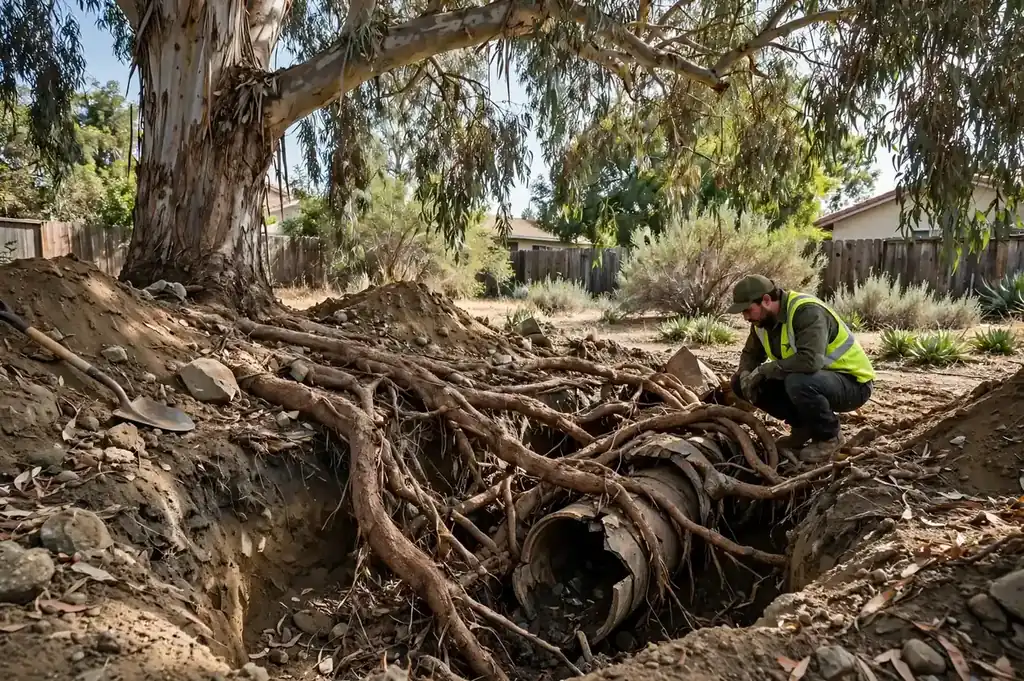 Tree Roots in Sewer Lines
Eucalyptus and pepper trees are common across Rancho Palos Verdes, and their roots find the opened joints in old clay laterals. Cu...
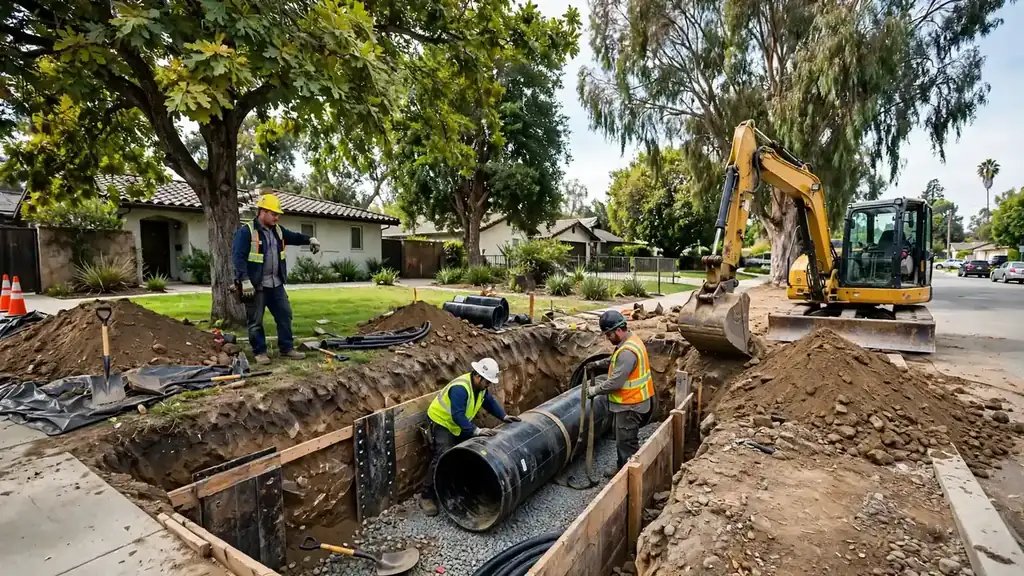 Sewer Replacement Process Step by Step
A sewer replacement follows the same steps in every Rancho Palos Verdes home: a call, a camera inspection, options from the findin...
Frequently asked questions
Questions people ask about portuguese bend landslide and your sewer line, answered plainly.
Yes, though more slowly. Dewatering wells cut the rate to around 0.8 inches a week by September 2026, about 92 percent below the earlier pace. That is real progress, but the ground has not stopped, and a pipe there still has to live with movement.
It is a coating and lining rehabilitation of the trunk sewer line, running from July 2026 to March 2027, covering about 9,362 linear feet of trunk line and 13 manholes in Rancho Palos Verdes. It repairs the public trunk, not the private laterals that connect houses to it.
While the ground keeps moving, no fix there is permanent. Lining or a new pipe buys working time, and then the ground shifts again and strains the repair. The work is still worth doing, since a working line beats a failed one, but it should be understood as time bought, not a problem ended.
Builders there learned to keep pipes where they can be seen and where they can flex. Steel runs with flexible couplings ride out small shifts that would pull a buried joint apart, and a line above ground can be inspected and adjusted without digging. The design copes with movement, but large shifts still overwhelm it.
Ordinance 692, in effect since September 2025, holds construction across roughly 715 acres of the landslide area. Sewer work that needs a permit, digging, or a new connection has to fit inside those limits, and the City is the authority on what is allowed while the moratorium stands.
More often than anywhere else in the city. Book a camera run after every heavy rain, after any spell of quicker movement, and whenever the lot shows a change, like a new crack, a leaning fence, or a hollow in the yard. Each recording filed beside the last one shows whether the pipe is holding or slipping.
Stop using water, keep people and pets away from the wastewater, and call for help. If the property is under an evacuation order or warning, follow that order first. A backup that affects several houses at once should be reported to the City and the County, because it may be a trunk or network problem.
Gas service in the area ended in August 2024, and grid electricity was still out as of November 5, 2026. A local emergency has been in force from October 2023, renewed every 60 days, and more than 200 homeowners were evacuated in September 2024.
Sewer line trouble in your Rancho Palos Verdes home?
Call Now to reach a local sewer professional. Describe the problem, where it is, and what the line has been doing.
Call now for sewer line help
Tap Call Now to reach a local sewer professional. Tell them where the problem is, what the line has been doing, and whether wastewater is coming into the home.
Hours: Mon–Fri 7:00 AM–10:00 PM PT · Sat 8:00 AM–10:00 PM PT · Sun 7:00 AM–9:00 PM PT
Before you call
- Stop using water if the line is backing up.
- Keep people and pets away from any wastewater.
- Note which drains are slow, and which one backs up first.
- Note whether the problem happens in heavy rain, or all the time.
- Have the age of the home ready, if you know it.