
Does Homeowners Insurance Cover Sewer Line Repair in California?
A standard homeowners policy in California almost never pays to replace a buried sewer lateral. Two endorsements change that picture, and this guide explains them in general terms.
Need help with your sewer line?
Call Now to reach a local sewer professional. Describe the problem, where it is, and what the line has been doing.
Hours: Mon–Fri 7:00 AM–10:00 PM PT · Sat 8:00 AM–10:00 PM PT · Sun 7:00 AM–9:00 PM PT
The short answer, and why it is short
A standard homeowners insurance policy in California almost never pays to replace the buried sewer lateral. The lateral is a buried pipe, and the reasons it fails — wear and tear, deterioration over decades, and tree roots — are the reasons a standard policy excludes. Wear and tear is the slow aging of the pipe, and a policy that covered wear and tear would be a maintenance contract, not an insurance policy. Deterioration is the same idea: a clay lateral that has aged for sixty years has deteriorated, and the deterioration is not a sudden event the policy is written to cover. Tree roots are excluded for the same reason: roots enter through open joints over years, and the damage is gradual, not sudden.
That short answer surprises many homeowners, because the lateral is part of the house, and the house is insured. But the policy insures the house against sudden and accidental damage — a fire, a storm, a burst pipe inside the house — and the lateral fails slowly, underground, over decades. The policy was not written for a pipe that ages, and the insurer will say so when a claim is made for a lateral replacement. The homeowner who learns that after the lateral has failed is learning it at the worst possible time, when the repair is already needed and the bill is already in front of them. The homeowner who learns it before the lateral fails can plan for it.
This guide is general information, not a coverage opinion. It explains how standard policies usually treat sewer laterals, what two endorsements usually do, and what sudden damage usually means, in the terms that trade sources and insurers use. It does not state what any particular policy covers, because policies differ, endorsements differ, and the only document that states what a given policy covers is that policy itself, with its declarations page and its endorsements. A homeowner who wants to know what their own policy covers should read it, and should ask their agent or insurer, with the policy in hand.
What a standard policy usually excludes
A standard homeowners policy usually excludes wear and tear, deterioration, and tree roots, and those three exclusions cover most lateral failures in Rancho Palos Verdes. Wear and tear is the aging of the pipe itself: clay tile that has served for sixty years, cast iron that has corroded for sixty years, and bituminous fiber that has softened and flattened. Deterioration is the process by which the pipe loses its strength and its shape, and the policy treats that process as maintenance, not as damage. Tree roots are the cause that most homeowners meet first, because the roots enter through open joints and widen them, and the policy treats root damage as a gradual cause, not as a sudden one.
The policy also usually excludes the cost of replacing the pipe itself when the failure is gradual, even when the result is sudden. A lateral that has been narrowing for years can back up suddenly, on a single day, and the backup feels sudden to the household. But the cause — the narrowing, the roots, the corrosion — built up over years, and the insurer will look at the cause, not only at the day the backup arrived. The backup itself may be covered in part, under a different part of the policy, and that part is described in the next sections. The pipe itself, and the cost of digging it up and replacing it, is usually not covered when the cause is gradual.
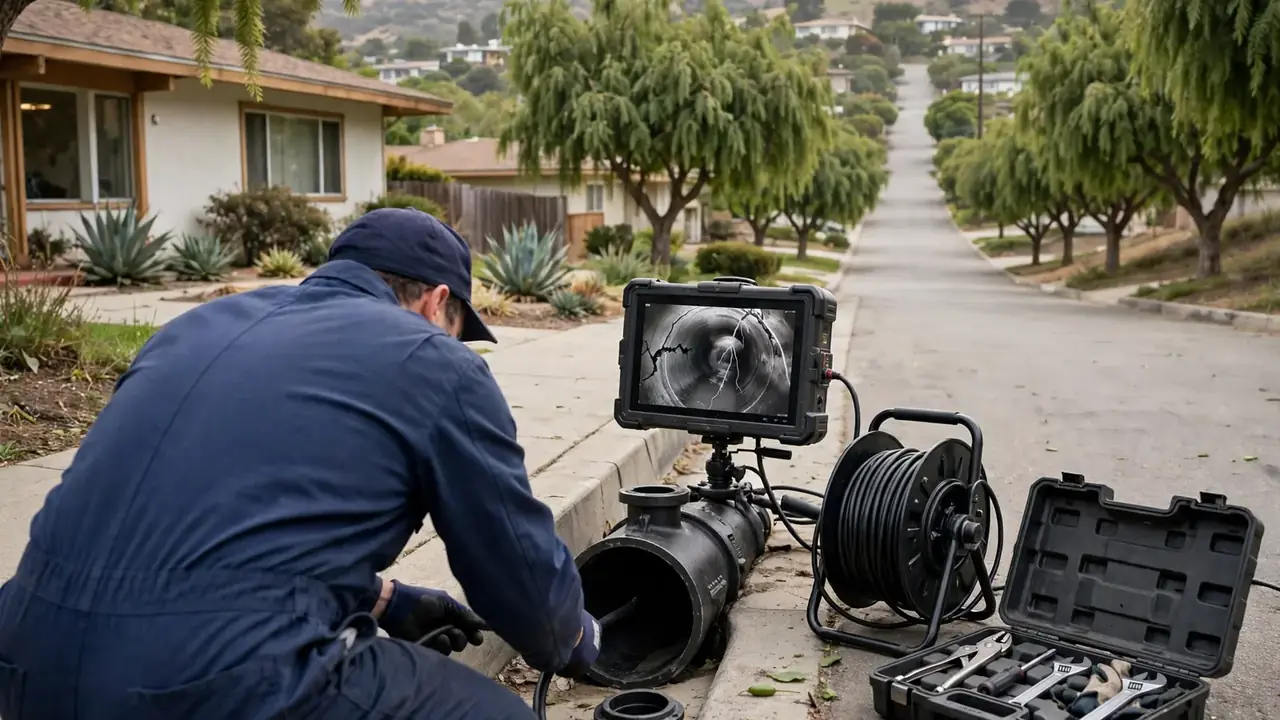
The exclusions are written into the policy, and they are the reason a lateral replacement is usually a property cost, not an insurance claim. The homeowner should read the exclusions in their own policy, and should ask their agent or insurer what they mean for the lateral under the yard. A homeowner who has a camera inspection showing the condition of the lateral can show that footage to the agent, and the agent can explain what the policy would do if that lateral failed. The footage is useful for that conversation, because it shows the pipe as it is, not as the homeowner imagines it to be.
Service-line coverage: the pipe itself
Service-line coverage is an endorsement — an addition to the standard policy — that covers the pipe itself, and it is the endorsement that matters most for a sewer lateral. Where a standard policy excludes the buried lateral, a service-line endorsement can cover the cost of repairing or replacing a service line, including the sewer lateral, when it fails for a covered reason. The endorsement usually covers the pipe, the excavation to reach it, and the restoration of the ground above it, up to the limit stated in the endorsement. The limit, the deductible, and the covered reasons are stated in the endorsement, and they differ from one policy to another.
The endorsement is usually inexpensive to add, and it is usually added at renewal or when the policy is written, not after the lateral has failed. A homeowner who adds it before the lateral fails has it when the failure arrives. A homeowner who tries to add it after the failure has already happened is too late, because the endorsement covers future failures, not failures that have already occurred. The homeowner should ask their agent or insurer whether service-line coverage is available on their policy, what it covers, what its limit is, and what it costs to add. The answer should be in writing, with the endorsement attached to the policy, so that the coverage is clear before it is needed.
Service-line coverage has its own exclusions and conditions, and the homeowner should read them. The endorsement may cover some causes and not others, may have a waiting period after it is added, and may require that the line be maintained. The homeowner should also know the limit, because the endorsement covers up to that limit, and a replacement that costs more than the limit leaves the rest to the owner. The endorsement is a real help for a lateral replacement, but it is not an open-ended promise, and the homeowner who reads it before the failure knows what it will do when the failure arrives.
Water backup and sump overflow coverage: the interior damage
Water backup and sump overflow coverage is a different endorsement, and it covers a different thing: the damage inside the house when wastewater backs up, not the pipe itself. When a lateral fails and sewage backs up into the lowest drain, the water damages floors, walls, furniture, and belongings, and the cleanup is a substantial job. Water backup coverage can pay for that interior damage, and for the cleanup, up to the limit stated in the endorsement. The limit is often a modest one, and the homeowner should know what it is, because a backup that damages a finished basement can cost more than the limit covers.
The distinction between the two endorsements is the distinction between the pipe and the water. Service-line coverage is about the pipe: the cost of repairing or replacing the buried lateral. Water backup coverage is about the water: the cost of cleaning up and repairing the damage the backed-up water caused inside the house. A homeowner can have one without the other, and a homeowner who has only water backup coverage will find that the insurer pays for the cleanup but not for the pipe, while a homeowner who has only service-line coverage will find that the insurer pays for the pipe but not for the cleanup. A homeowner who has both has the fuller picture, and the two endorsements together are the combination that covers a lateral failure most completely.
The homeowner should also know that water backup coverage is usually an endorsement, not part of the standard policy, and it has to be added. A standard policy often excludes water that backs up through a sewer or a drain, and the endorsement is what adds that coverage back. The homeowner should ask their agent or insurer whether water backup coverage is on their policy, what its limit is, and what it costs to add. The declarations page of the policy shows the endorsements that are on it, and the homeowner who reads that page knows what is covered before the backup arrives, rather than learning it after the water is already in the house.
Sudden accidental damage: a different case
Sudden accidental damage is a different case from wear and tear, and it is treated differently by most policies. A lateral that is crushed by a vehicle driving over it, a lateral that is broken by excavation on the lot, or a lateral that is damaged by documented ground movement that shifts the pipe suddenly — each of those is a sudden event, not a gradual one, and a policy that covers sudden and accidental damage may cover it. The key word is documented: the damage has to be shown to be sudden, and the showing is usually the camera footage, the photos of the event, and the written account of what happened and when. A lateral that failed gradually and is described as sudden will not be treated as sudden, because the camera shows the gradual cause.
Ground movement is the sudden cause that matters most in Rancho Palos Verdes, and it is also the hardest to document. The Peninsula has ground that moves, and a lateral can be offset or cracked by a shift that happens over a short period, especially after heavy rain or in a landslide area. A homeowner who believes the lateral was damaged by ground movement should have the camera inspection that shows the damage, the record of the movement — the dates of the rain, the City's land-movement updates, or the visible cracks on the lot — and the written account that ties the two together. The insurer will ask for that record, and the homeowner who has it is in a stronger position than the homeowner who has only a description of the backup.
The homeowner should report sudden damage promptly, and should keep the record. Take photos of the water and the damage before anything is cleaned, note the time the backup started and what was happening on the lot, and keep the camera findings and the written account with the photos. The insurer may send an adjuster, and the adjuster will want to see the damage and the cause. A homeowner who has the record can show it. A homeowner who has cleaned up and thrown away the evidence has nothing to show, and the claim is harder for it. Sudden damage is a real category, but it is a category that has to be proved, and the proof is the record.
Reading your policy and talking to your agent
The declarations page is the first page of the policy to read. It lists the coverages, the limits, and the endorsements that are on the policy, and it shows whether service-line coverage and water backup coverage are there, and what their limits are. A homeowner who cannot find those endorsements on the declarations page probably does not have them, and the agent or insurer can confirm that. The policy itself, with its exclusions and conditions, is the longer document, and the homeowner should read the sections on wear and tear, deterioration, tree roots, and water backup, because those are the sections that decide what happens when the lateral fails.
The conversation with the agent should happen before the lateral fails, not after it. The homeowner should bring the camera footage of the lateral, if there is one, and ask three questions: does the policy cover the lateral itself, does it cover the interior damage from a backup, and what would it take to add the endorsements that are missing. The agent's answers should be in writing, with the endorsements attached to the policy, so that the coverage is clear. A homeowner who has that conversation at renewal, with the policy in hand, knows what is covered before it is needed, and the homeowner who has it after the backup is asking the wrong questions at the wrong time.
The last step is the record. Keep the policy, the declarations page, the endorsements, the camera footage of the lateral, and the written findings together with the house file. When the lateral fails, the homeowner will need all of them: the footage to show the pipe, the policy to show the coverage, and the endorsements to show the limits. A homeowner who has the record can make a claim with evidence. A homeowner who does not have it can only describe what happened, and the description is worth very little. The lateral is the least visible part of the house, and the policy is the least read document in the house, and the homeowner who knows both is the homeowner who is ready when the lateral fails.
Services for this situation
Related guides
 Sewage Backup in the Lowest Drain
Wastewater coming up through the lowest drain is an urgent problem. Stop using water, keep away from the wastewater, and call for ...
 Rain and Sewer Backups
A backup that happens only when it rains is a different problem from one that happens in dry weather. It points to the street side...
 What to Have Ready Before Sewer Repair
A little preparation before sewer repair saves time on site and helps the crew find the cause faster. Here is what to have ready: ...
Frequently asked questions
Questions people ask about sewer repair insurance in california, answered plainly.
Almost never, under a standard policy. Wear and tear, deterioration, and tree roots are usually excluded, and those are the reasons most laterals fail. Service-line coverage, an endorsement added to the policy, is what can cover the pipe itself. This is general information, not a coverage opinion about any particular policy.
It is an add-on to a homeowners policy that can pay for fixing or replacing a buried service line, the sewer lateral included, when it fails for a covered reason. It generally extends to the pipe, the digging to reach it, and putting the ground back, up to the limit written in the endorsement.
It is an endorsement that can cover the damage inside the house when wastewater backs up, and the cleanup, up to the limit stated in the endorsement. It covers the water damage, not the pipe itself, and its limit is often a modest one.
They cover different things: service-line coverage is about the pipe, and water backup coverage is about the interior damage from backed-up water. A homeowner who has only one will find that the other part is not covered. The declarations page shows which endorsements are on a policy.
Sudden accidental damage is a different case from wear and tear. A lateral crushed by a vehicle, broken by excavation, or damaged by documented ground movement may be covered, but the damage has to be shown to be sudden, with camera footage, photos, and a written account of what happened and when.
Read the declarations page, which lists the coverages, limits, and endorsements, and read the exclusions for wear and tear, deterioration, tree roots, and water backup. Ask your agent or insurer with the policy in hand, and get the answers in writing with the endorsements attached.
No, the add-on only applies to failures that happen after it is in place, so it is normally taken out at renewal or when the policy is first written. Anyone who adds it while the lateral is still working will have it when the failure eventually comes.
Keep the policy, the declarations page, the endorsements, the camera footage of the lateral, and the written findings together. Take photos of any backup and damage before anything is cleaned, and note when it started and what was happening. The record is what a claim is built from.
Sewer line trouble in your Rancho Palos Verdes home?
Call Now to reach a local sewer professional. Describe the problem, where it is, and what the line has been doing.
Call now for sewer line help
Tap Call Now to reach a local sewer professional. Tell them where the problem is, what the line has been doing, and whether wastewater is coming into the home.
Hours: Mon–Fri 7:00 AM–10:00 PM PT · Sat 8:00 AM–10:00 PM PT · Sun 7:00 AM–9:00 PM PT
Before you call
- Stop using water if the line is backing up.
- Keep people and pets away from any wastewater.
- Note which drains are slow, and which one backs up first.
- Note whether the problem happens in heavy rain, or all the time.
- Have the age of the home ready, if you know it.